Tuesday, February 19, 2013

Bangkok


“Illicit drug trafficking will be punished with death penalty,” a sign warns at the Thai side of the Cambodian border, but written in that jagged lightning bolt font used for the Harry Potter movies, as if to say, “drug trafficking will be punished with death penalty and a deduction of ten points from Gryffindor!”  The departure line on the Cambodian side moved at a glacial pace and the Thai side was even worse.  Behind me a Chinese tourist crept alternatingly on my left and right sides seeming ready to pounce in front of me, as if leaving a finger’s length of space between myself and the person in front of meant forfeiting my position in line.  She spent the whole afternoon nipping at my heels.  The terrible human like wailing of caged pigs occasionally added to the ambiance as obscenely packed cargo trucks full of Thai swine were made into exports as they crossed the border.  The aroma of their filth and despair wafted in behind them.  At last, inside the customs office, fans offered relief from the heat and televisions some respite from boredom.  10 minutes with a Thai daytime variety show confirmed nearly every uncomfortable stereotype I had in my head about Thailand’s lax attitudes toward sex and gender roles.  The show was hosted by grown men dressed like babies in pink and white gowns, and the talent consisted of adolescents of occasionally indeterminable sex singing, dancing, and dressing like adults.  There’s a lot of slapstick and tushy slapping.  At some point one of the man-babies picks up a maybe-boy-maybe-girl wearing a wig and a gown revealing lots of leg and starts kissing him/her on the tummy.  It had me shuddering to think what kind of antics happen in Thailand outside of television broadcasting.

It had been nearly two and a half months since I had seen a familiar face, and the accumulation of loneliness and discomfort had diminished my spirit of adventure, but waiting for me in Bangkok was two Ericas, friends from New York who were also planning to be in Thailand.  Reuniting with them – seeing their faces – and conspiring adventures to come brought a complete resurgence to my spirits and made being on the road feel like home again.


One of the Ericas, Camille let’s say, has spent plenty of time in Thailand and was happy to share her experience and companions with the two of us.  We stayed in a spacious apartment full of expats from all over the world.  Other travelers like us also passed in and out of the place and the nightly shuffling of human beings meant every morning I woke up in a different part of the apartment.

Canals are still an important way to get around in Bangkok

In total, we stayed in Bangkok an entire week, but I don’t have a week’s worth of Bangkok to relate because I spent the entirety of my time there ill.  And it’s my fault, too.  I was nurturing a mild case of food poisoning from Cambodia and didn’t let that stop me from regaling my reuniting with friends with great quantities of Thai beer.  My mild sickness coupled with a hangover and made me vulnerable enough for a nasty cold virus and maybe something else.  My sinuses felt inflated enough to crush my teeth to powder, I had migraines that increased in severity as the day passed on, and worst of all, I suffered a crippling fatigue that made it difficult to leave the apartment.  The building, though, had a swimming pool… so I guess in some way, I picked a fine place to be sick (though I did find myself terribly disappointed that I couldn’t better enjoy this exciting city and the great new people I met there).

Protective talismans are popular with many Thais

So far, Bangkok is the only truly modern city I’ve seen in Southeast Asia (oh, I forgot about Kuala Lumpur).  The metro rail is fast, clean, and efficient, the commercials playing in fancy malls and in the subway cars have impeccable production value, and Bangkok’s very fashion minded youth look like they work at an Urban Outfitters.  Bangkok has a reputation for exceptionally cheap tailors so I made appointments to have a sports jacket that I had been dreaming of owning cut from scratch.  After choosing the fabric, being measured, and laying down all my specifications, however, the jacket’s cost ended up being marginally less than my trusted tailors in Los Angeles or New York would have cost, so I made some silly excuse and left the tailors’ district disappointed.  This experience would repeat itself at the hip weekend market and a few malls. I was hoping to scoop up lots of loot in Bangkok and show up to Hong Kong and Los Angeles looking like a baller, but with frustrating consistency everything was too small, too Asian, or too shoddily constructed – and if it wasn’t any of those things, that meant the price tag would somehow match or even exceed those of New York’s, so I eventually gave up on my dapper on the cheap aspirations.


It was clear very quickly that Thailand and Cambodia are close cultural cousins – reflected most immediately by the classic architecture, music, dress, and food – but I’m reluctant to say Cambodia is left the paler of the two in almost every way.  Thailand’s monasteries are similar but dazzling by comparison in scope, color, and intricacy.  Even the tiny spiritual bird houses that sit outside every home and business are more impressive here.  There’s an expectation that big businesses care for more extravagant shrines: outside of one hotel a large shrine houses a golden four headed Brahma, and a small team of classically trained dancers await donations from the public.  When someone feels particularly grateful to the gods for something, they can show their appreciation by paying the dancers to perform on their behalf.  Behind another hotel, another shrine has become famous for its powers of instilling fertility and is rampant with carefully arranged phalluses – enormous penises stacked in rows and perched erect along the garden’s walkways.  Thai food has so many similarities to the neighboring Cambodia’s cuisine, but it’s difficult to compare.  Thai food is so good!  Spicy, fresh, sweet, sour, and salty – and the street food is some of the cleanest in the region.  My taste buds have been the second happiest they’ve been on this journey (sorry Thailand, but it will take more than that to dethrone India in my heart – or in my mouth, rather).


I don’t mean to make these comparisons to belittle Cambodia – I truly admire Cambodia – but it seems to me Cambodia’s relative mildness could be a direct result of its recent and tragic history.  The Khmer Rouge killed artists and educators first.  They destroyed museums, schools, and monasteries.  Culture was a great casualty of the genocides, and Cambodia is still suffering a handicap as a consequence.  The Khmer people once ruled nearly all of peninsular Southeast Asia and it makes me bitter to think how much they’ve lost to that pointless genocide.

Being overspent, sick, and tired, my camera spent more time holstered or in my bag than normal.  Or perhaps this was mostly due to the fact that I was now traveling with Erica Camille, who happens to be a terribly good photographer.  Either way, here's a link to her own travel blog:

http://ericacamilleproductions.com/blog/2013/01/30/travel-blog-bangkok/

Until Camille and I part, I'll be supplementing my posts with links to her own.  You can get a different take on some of the same events and enjoy her beautiful eye on the world.

Sunday, February 17, 2013

Angkor


Lying on a mattress in my bamboo shack I could hear geckos slap their tails against the bamboo walls.  From the rooftop bar across the patio, I could hear the thumping bass of techno and cheering drunk Europeans.  In the dark under my mosquito net, I could hear the crinkle of plastic wrap and dry crumbling – something nibbling on my baguette, my intended pre-dawn breakfast.  Too much of the outside world seeps in through the cracks.  Sleep doesn’t come easy in my bamboo shack, but it does eventually come.  Until my alarm clock rouses me.  It’s my fourth and last full day in Siem Reap and I had been saving the best for last.

While I hop on my bike to start my day, others are stumbling back from the bars.  It’s five thirty in the morning.  In a corner store, full of western foods at western prices, I replace my molested baguette.  Outside an inebriated Frenchman is trying to dance with a timid Cambodian security guard.


If the backpacker scene in India is for hippies and Nepal for the trekkers, then the backpacker scene in Cambodia is for frat party douchebags and I happily flee the tourist village in Siem Reap for the complex of ruins to the north.  Typically tourist villages are integrated into the cities as they are, but the foreigner zone here is baptized in the waters of tourism and seems to be for foreigners alone.  My mealtimes are usually characterized by finding modest looking places full of locals, but here none of the restaurants radiating from my hotel would have any Cambodians in them except for those in the staff.  The inflated tourist prices mixed with my coming back from the temples too exhausted to find my cheap local eats saw me spending more on mediocre meals than I did on my greatest splurges in the Indian subcontinent, and my daily tallies showed me I was spending more here than I was in Burma.


On the road, the black sky embraces hints of indigo, and this quickens my pace.  I have someplace to be.  The morning crows of roosters slowly get replaced by the wild sounds of the jungle.  Phantom squeaks of invisible frogs bounce around the edges of marshes, ripsaw cicadas drone in the trees, and the funny warbles of jungle birds sound oddly like the way laser beams do in cartoons – with eyes closed it almost sounds like a space battle in stereo.  Sinewy trees, the sum of many inseparable trunks, reach up to meet at the forest canopy, and parasitic vines come spiraling back down.  Oh, how I love the jungle.


The days before had been unfortunately overcast, particularly when I was exploring the temples of Angkor on foot, leaving my photos washed out, lacking contrast, and always backlit, no matter the angle.  Somehow the clouds timed their partings for when I was hustling about on the seat of my bicycle, leaving me more vulnerable to sunburn and drenching sweat.  On my second day I had biked over 80 kilometers on my crappy cruiser style bicycle, leaving my bottom quite tender.  I would rehydrate with chilled young coconuts, and on the longest stretch of my longest ride, I found vendors selling a candy made from palm sap cooked in great kilns.  There were maybe 50 of these candy stalls in a row all selling the same palm candy packaged in palm leaves and I wouldn’t find them anywhere else.  The palm candy had all the natural fattiness you expect from coconut but with a sumptuous element of fruitiness.  The texture is chalky at first but grows malty as it melts in your mouth.


The cloudiness wasn’t supposed to break until the day I was to depart, so I tacked on an extra day and saved all the sights I was the most excited about for later.  I would see them from a distance as I commuted about the complex of Angkor in pursuit of its lesser treasures, and they would taunt me from behind great walls, moats, and jungle forests.


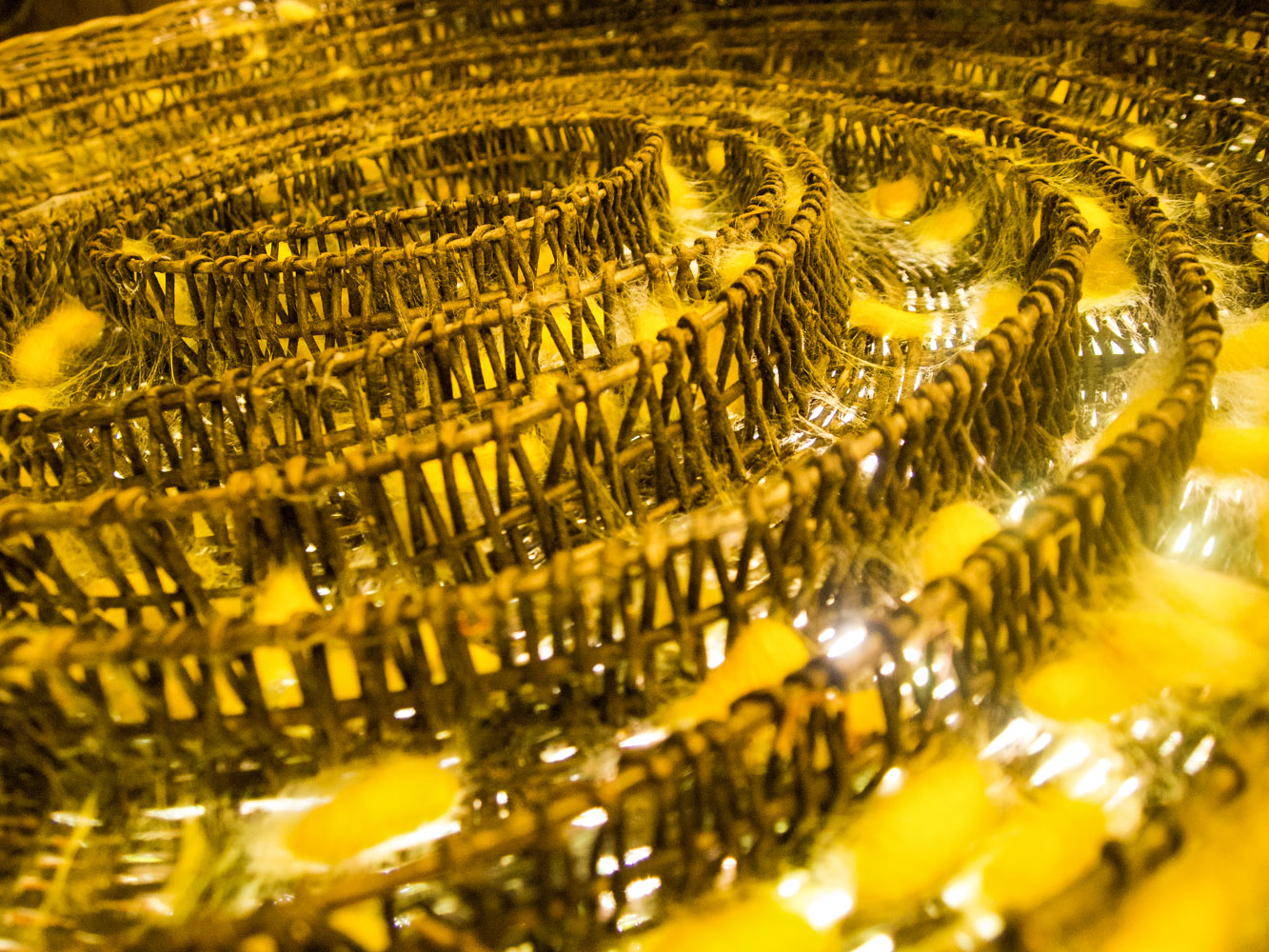
On my bonus day I visited a silk farm and witnessed every stage of silk production.  Great rows of mulberry bushes would provide leafy sustenance for the silk worms, and every variety of mulberry leaf would end up producing a different quality of silk.  Silk moths are bred and die shortly after giving birth.  Their offspring munch until ready to cocoon themselves in yellow thread.  The cocoons would then be boiled by the dozens and with a large wooden fork and a loom, their silk is wrapped into neat spindles and the leftover silkworms are ready to be snacked upon (our guide’s son found them irresistible).  The silk is then dyed, dried, and woven through complex bamboo looms into intricate scarves, ties, throw pillows, whatever.


That evening I also took a tour of the local wats (monasteries), the second of which I happened upon a funeral.  The body was burned under an open air pagoda.  The mourners sat together dressed in white and listened to monks chant hypnotically.  Many had shaved their heads in grief.  One of the guests ambled over to inform me, “he die by drink too much wine.”  On the other side of the monastery, next to a bustling street market, a young man entered to find a slightly private place to take a piss.  “Where you from?” he asked while peeing beside a pagoda.  He then informed me I should take off my hat around the pagodas, so as to be respectful… while he was peeing on a pagoda.

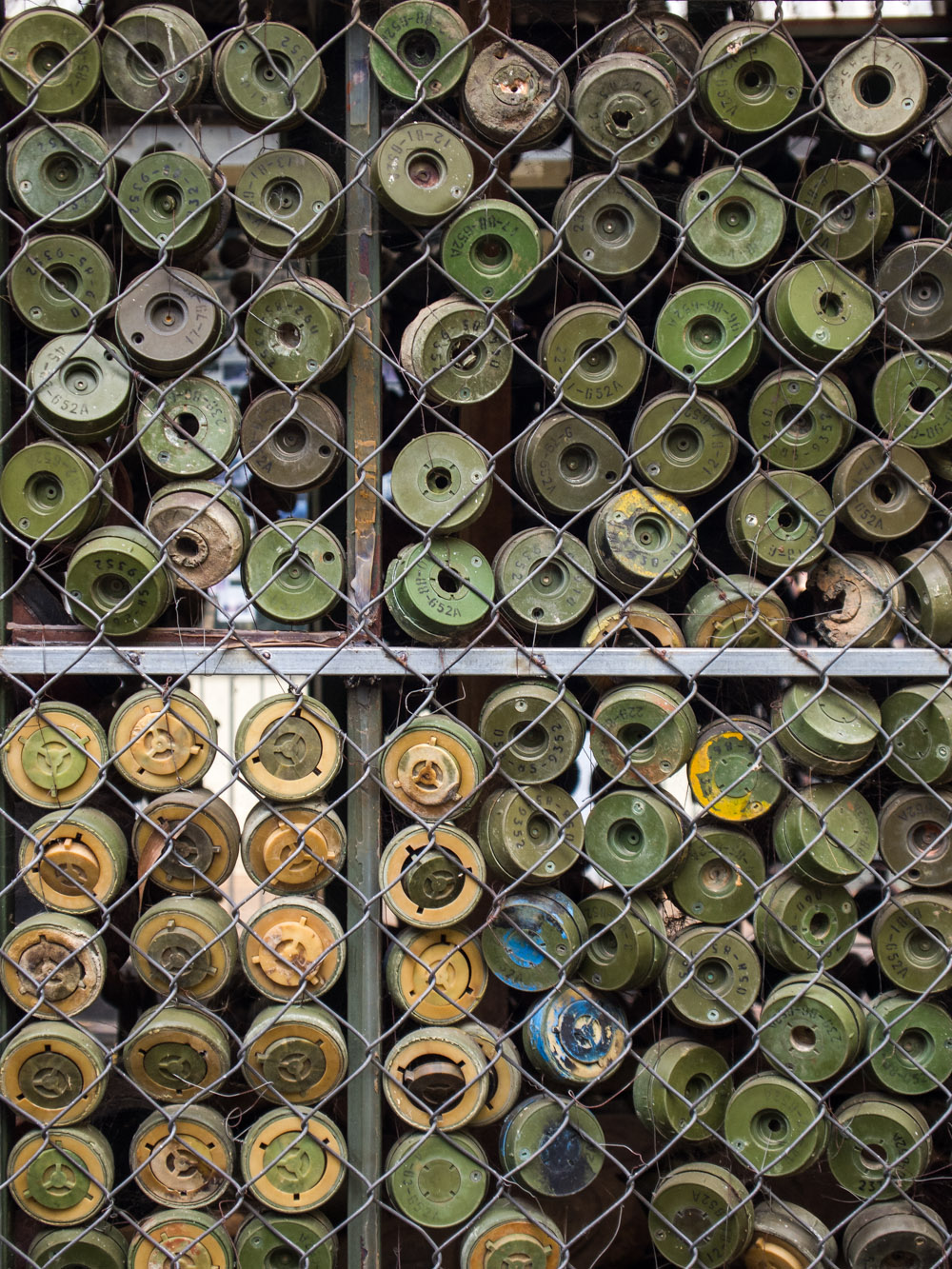
Northeast of the heart of the temple complex is a landmine museum founded by an ex-member of the Khmer Rouge.  Before defecting, Aki was a conscripted child soldier and landmine specialist.  On the battlefield, he had deceived enemy combatants by leaving behind ammunition clips that would unleash a lethal neurotoxin when fired.  As an adult and free man, he has devoted his life to the disarmament of landmines in Cambodia and has personally disarmed tens of thousands of landmines – including landmines he likely laid himself, but mostly mines dropped by American planes in effort to disrupt supply lines to the Viet Kong.  The museum is full of disarmed mines, rockets, bombs, and claymores, and is also home to two dozen or so children who have been disfigured by or otherwise affected by landmines.  All the proceeds go to the orphanage.


Antipersonnel landmines are deliberately designed to maim instead of kill, as injured soldiers and civilians are more costly to tend to than dead ones.  The devastation landmines can wreak upon human bodies is abundantly clear when traveling around Cambodia.  Limbless beggars are tragically plentiful in any urban location, often legless on hand powered carts, and I had seen at least five bands of crippled musicians performing around Siem Reap, the members each being left blind or limbless thanks to chance encounters with leftover landmines.  Most countries in the world have since signed a U.N. drafted treaty prohibiting the manufacture and use of antipersonnel mines.  Notable holdouts include India, China, Burma, and the United States, with the U.S. insisting an exception for the Korean border be made.


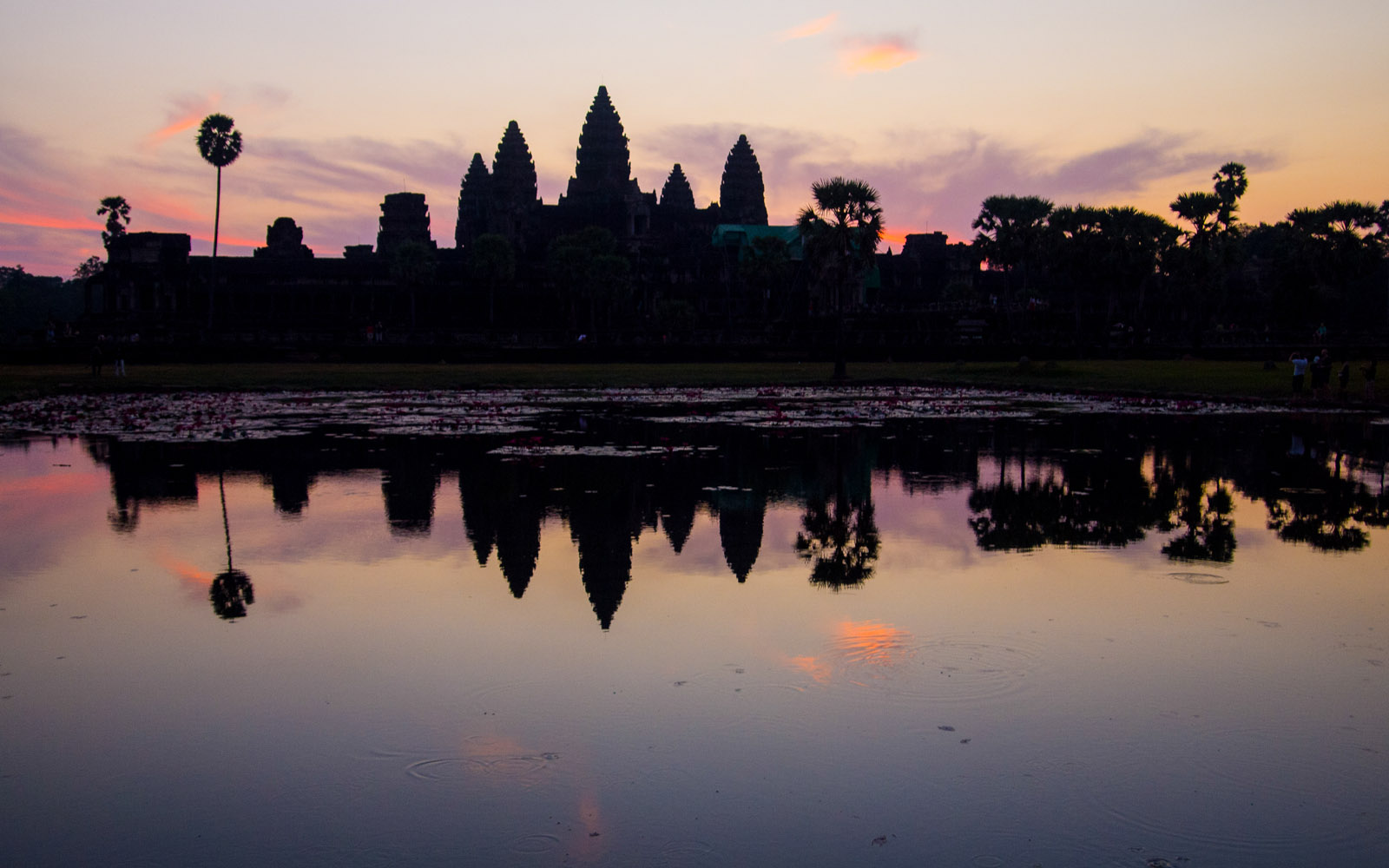
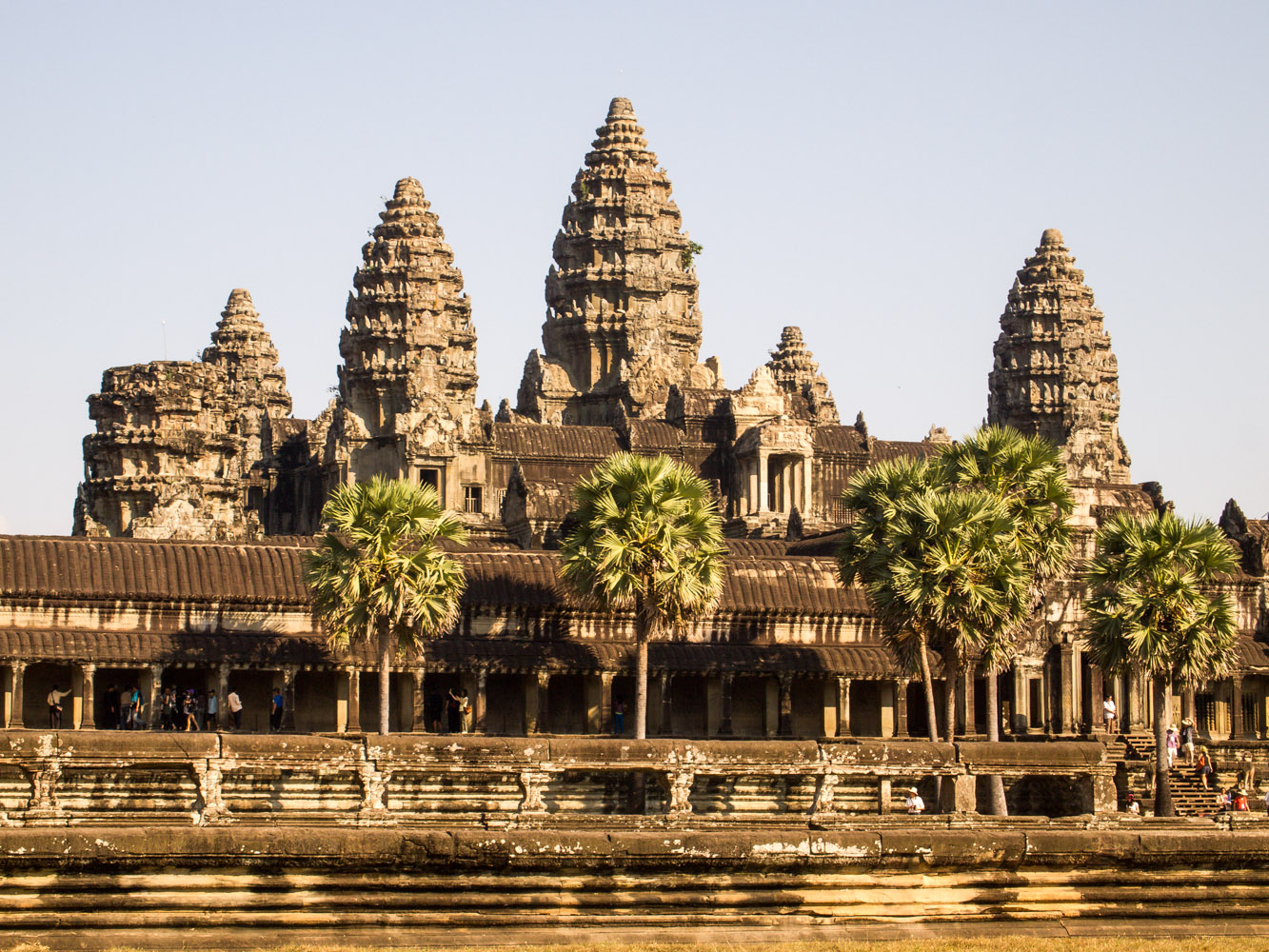
Well, I began this entry discussing my final and best day here, and I suppose I should stop skipping around it.  So, I was stealing through the jungle in the early morning so that I could watch the sun rise from behind the mountainous temple silhouette of Angkor Wat, the largest religious building in the world and the greatest source of pride for the Khmer people.  A central peak in the temple looms over four smaller peaks in the corners, several layers of walls, a grand courtyard, and a massive moat once full of crocodiles.  The same silhouette I saw reflected in the ponds preceding the temple in the cracks between lily pads also graces the Kingdom of Cambodia’s flag.  Like many of the temples in the region, Angkor Wat was dedicated as a Hindu temple, but has been since converted to honor Buddha by the mere addition of golden Buddhas in the hallways.


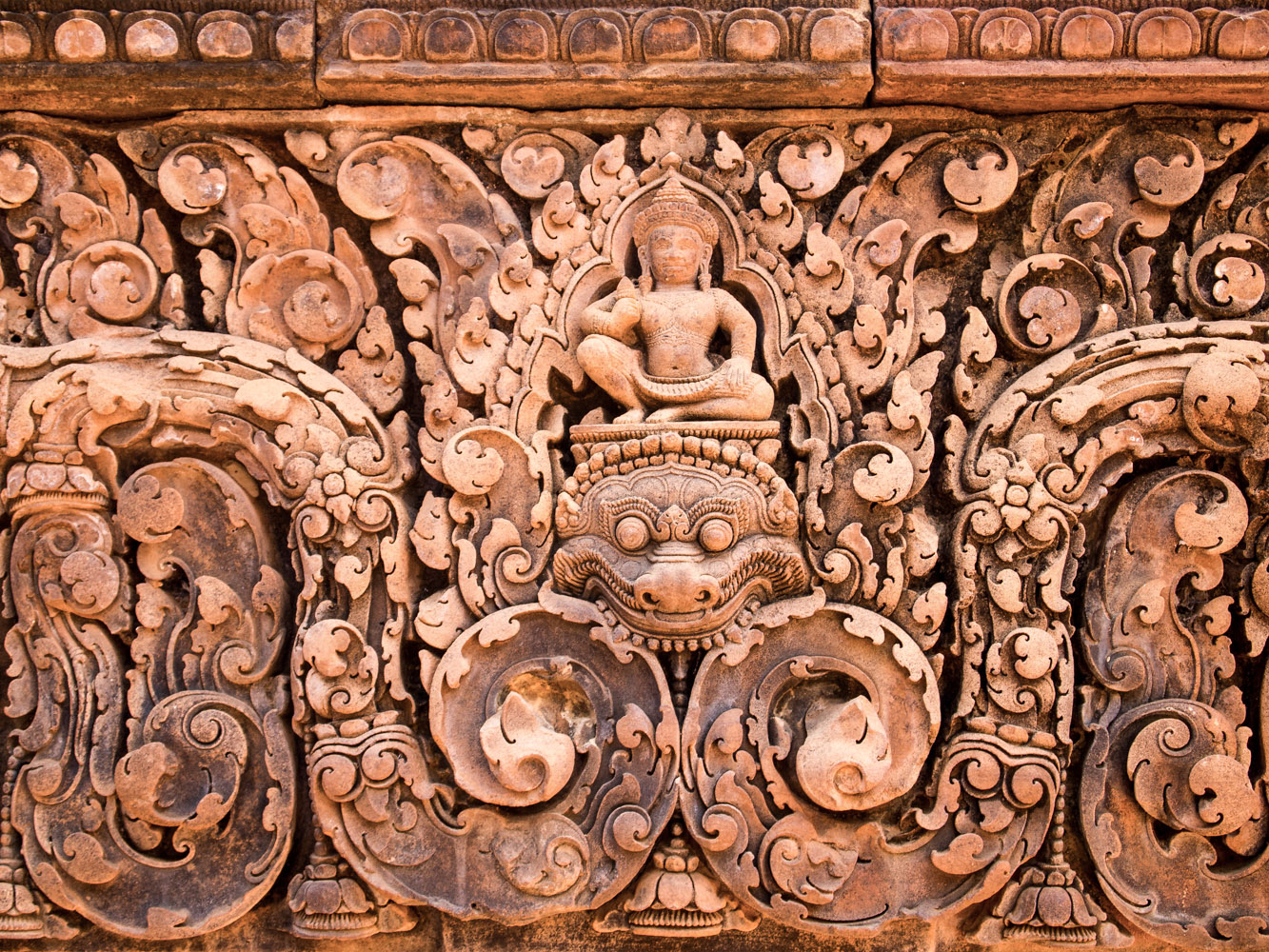
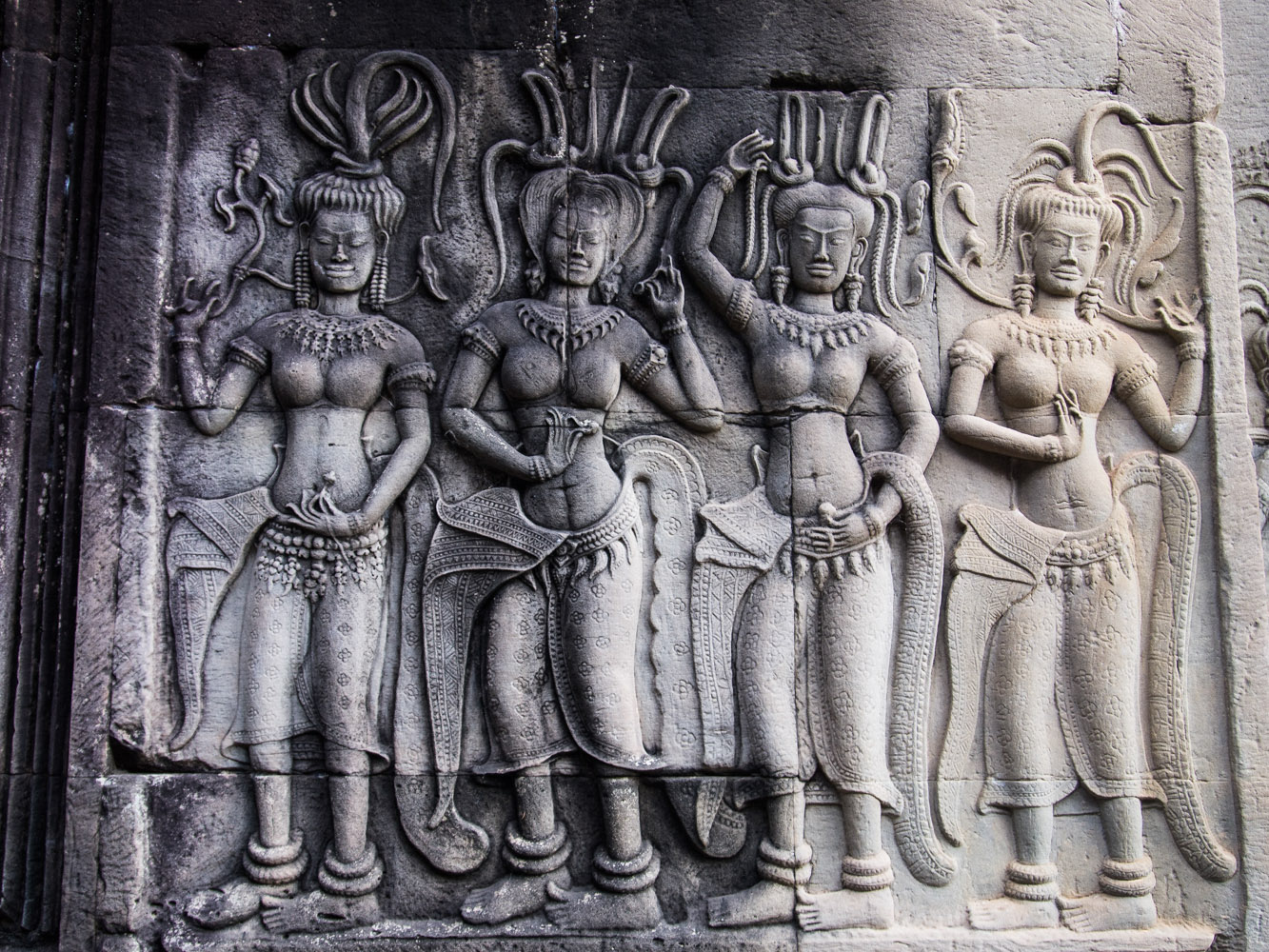
The outermost layer of walls is engraved with epic depictions of battles, both historical and otherwise.  In one panel, Yama, the god of death (and also the local name for crystal meth), sits indifferently as he grants access to heaven or condemns the recently departed to an eternity of suffering (much like Jesus in the last judgment paintings I love so much).  Many of the halls are decorated with depictions of Asparas, Khmer nymphs with terribly mannish faces and wild haircuts that are nothing short of fabulous.


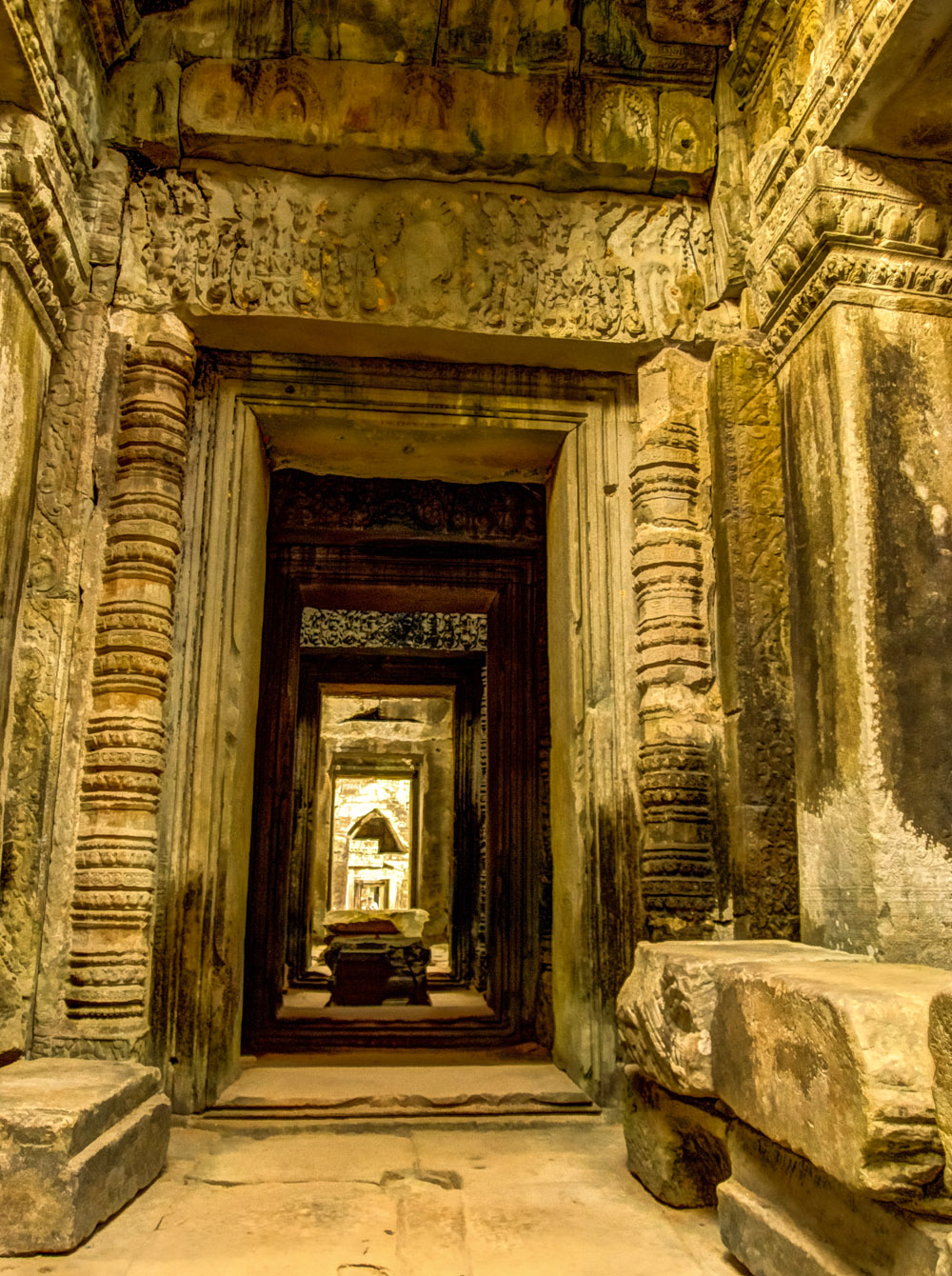
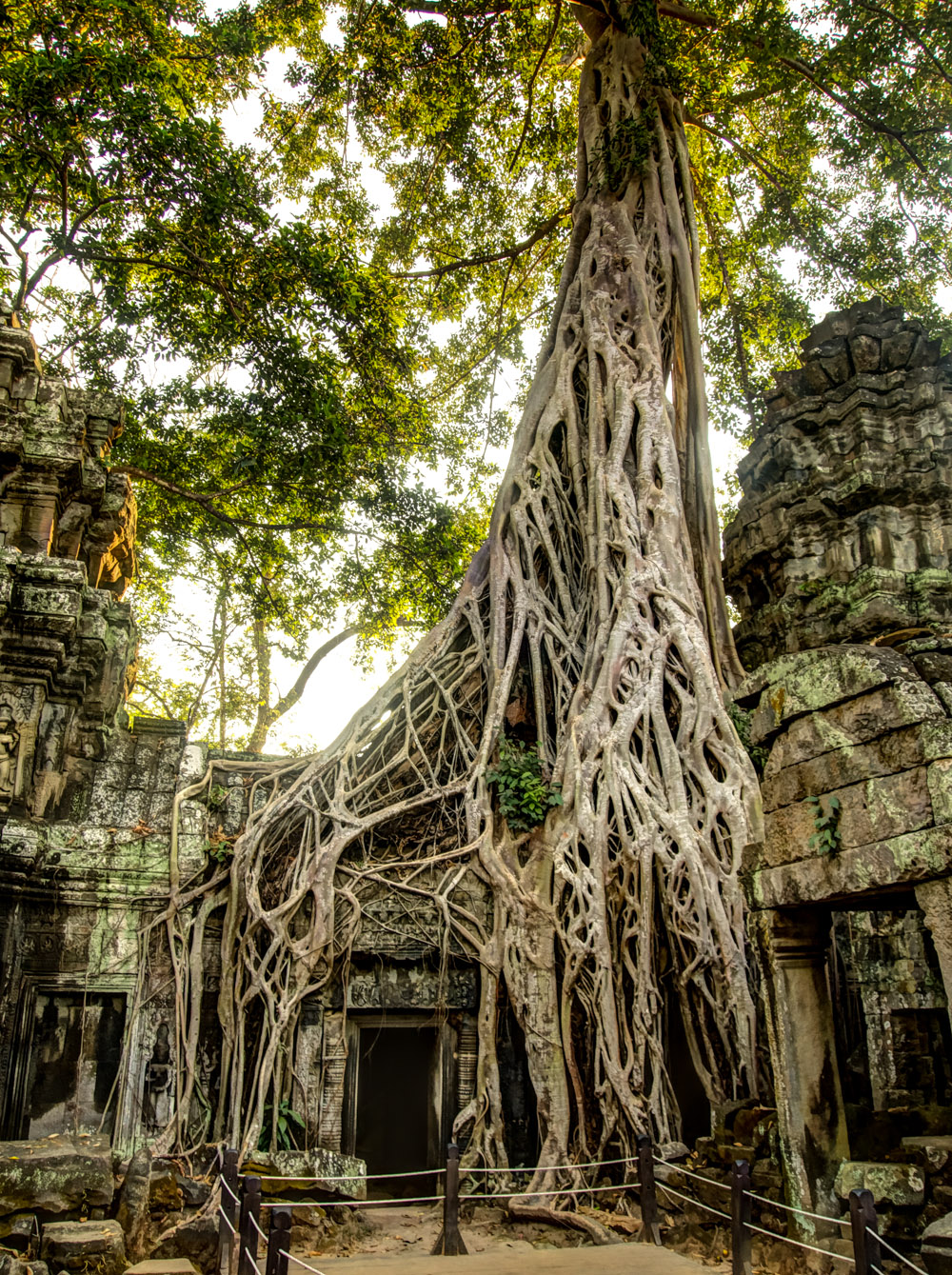
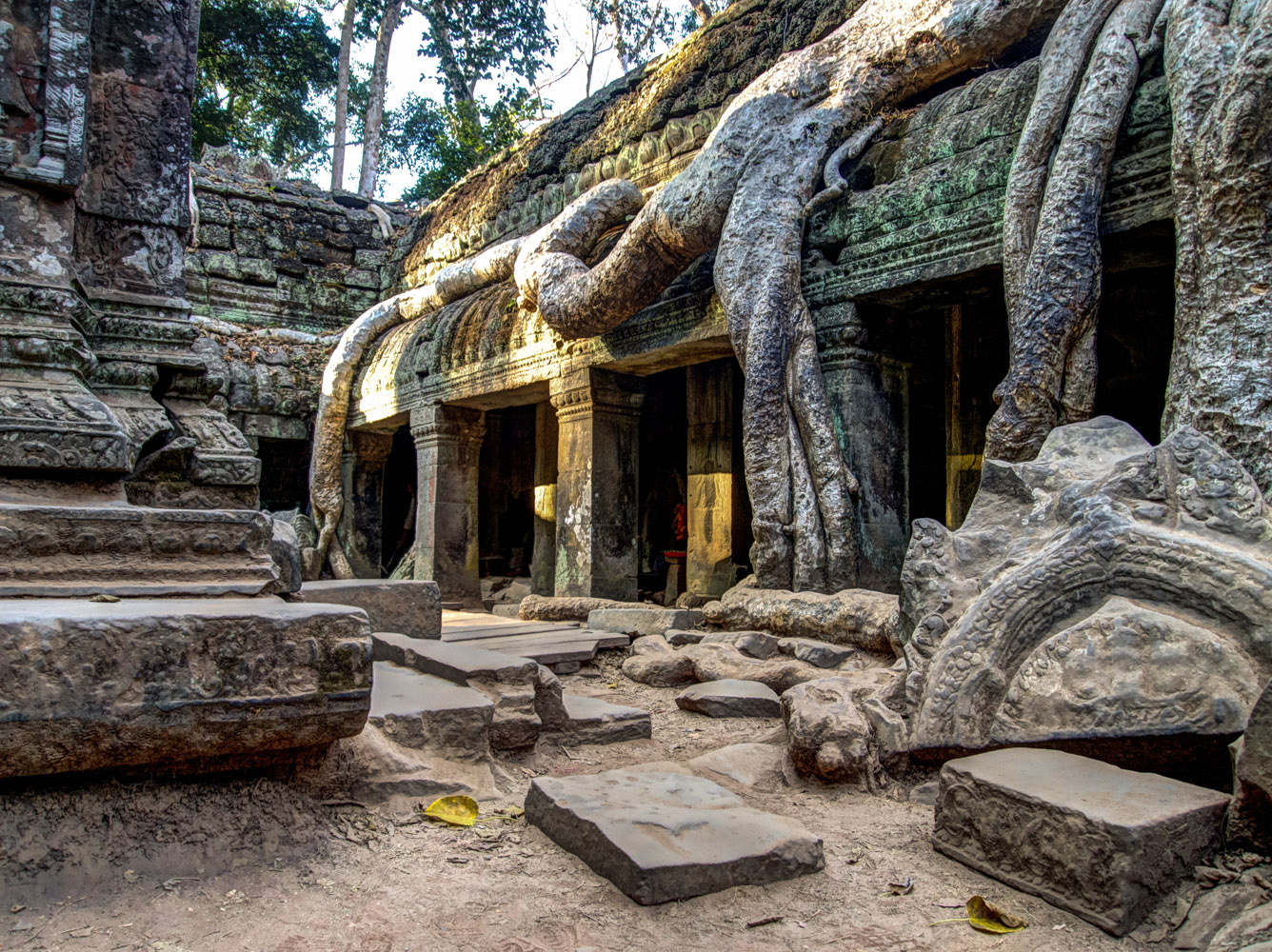
Hoping to stay a step ahead of the tour groups, after sunrise I hustled over to Ta Prohm, a tremendous temple overrun by even more tremendous jungle growth and made famous by Lara Croft’s battles in Tomb Raider.  In the post-dawn morning light, the sun’s rays caught the green leaf edges of countless leaves and bathed the scene in soft emerald light.  Testifying the might of nature over the triumphs of man, huge trees erupt from the temple stones in the most artfully unlikely ways.  The arches of doorways bulge with strangling tree roots, simultaneously holding the stones together and causing the constructions to explode in the slowest of slow motion.  Whole passageways are made impenetrable by the flooding of roots.  The place was a battlefield between the most beautiful expressions of nature and man, and enjoyed with near solitude, I found its aura intoxicating.  I returned in the afternoon to enjoy a few specific sights that I thought would benefit from the sun hanging higher and on the other side of the sky, but then I found myself hugging a wall to keep from being tugged away in a terrible current of Russian and Chinese tour groups.  I counted three taxis in the parking lot when I was first in the temple.  When I had returned, there were well over 200.


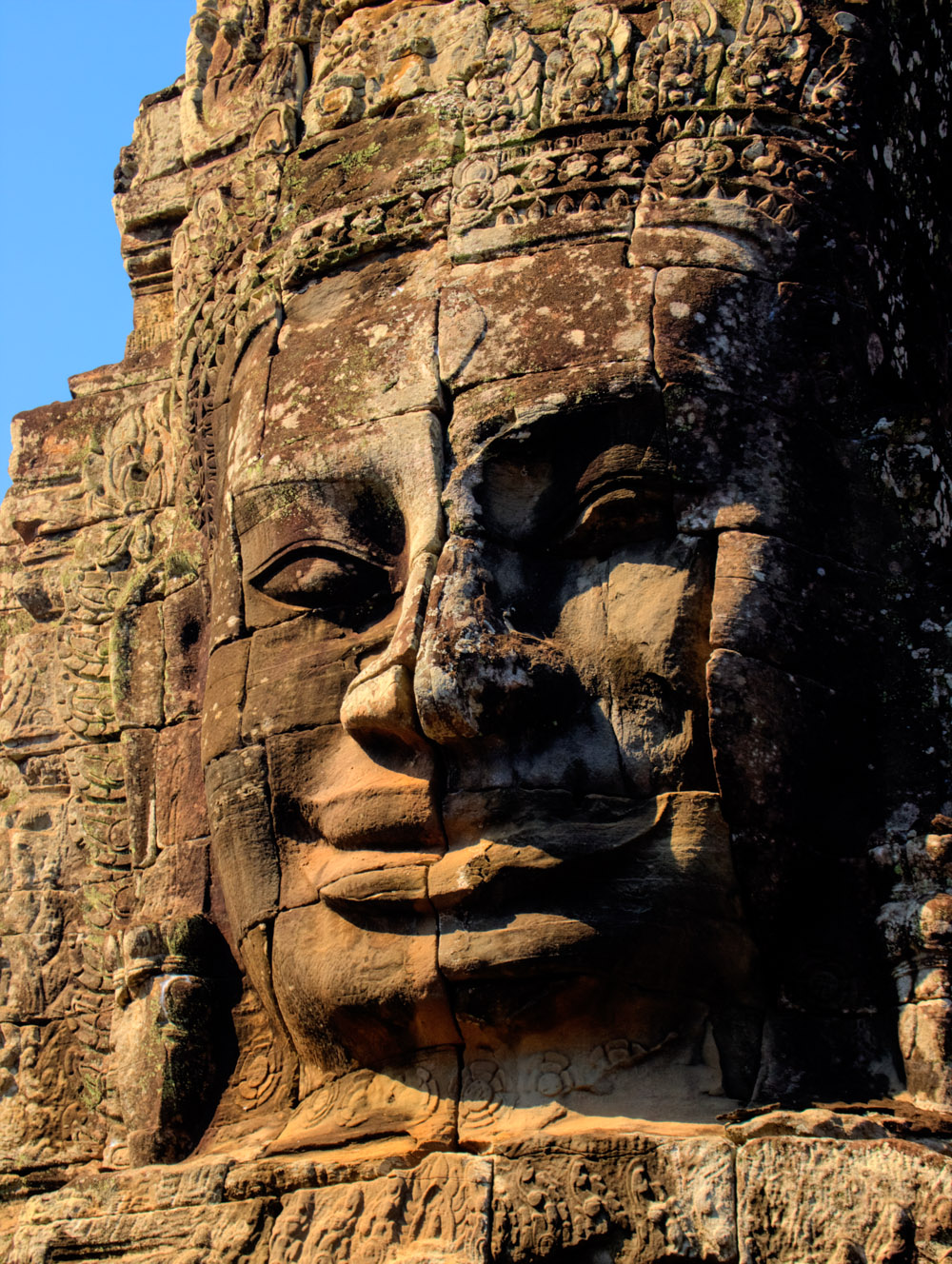
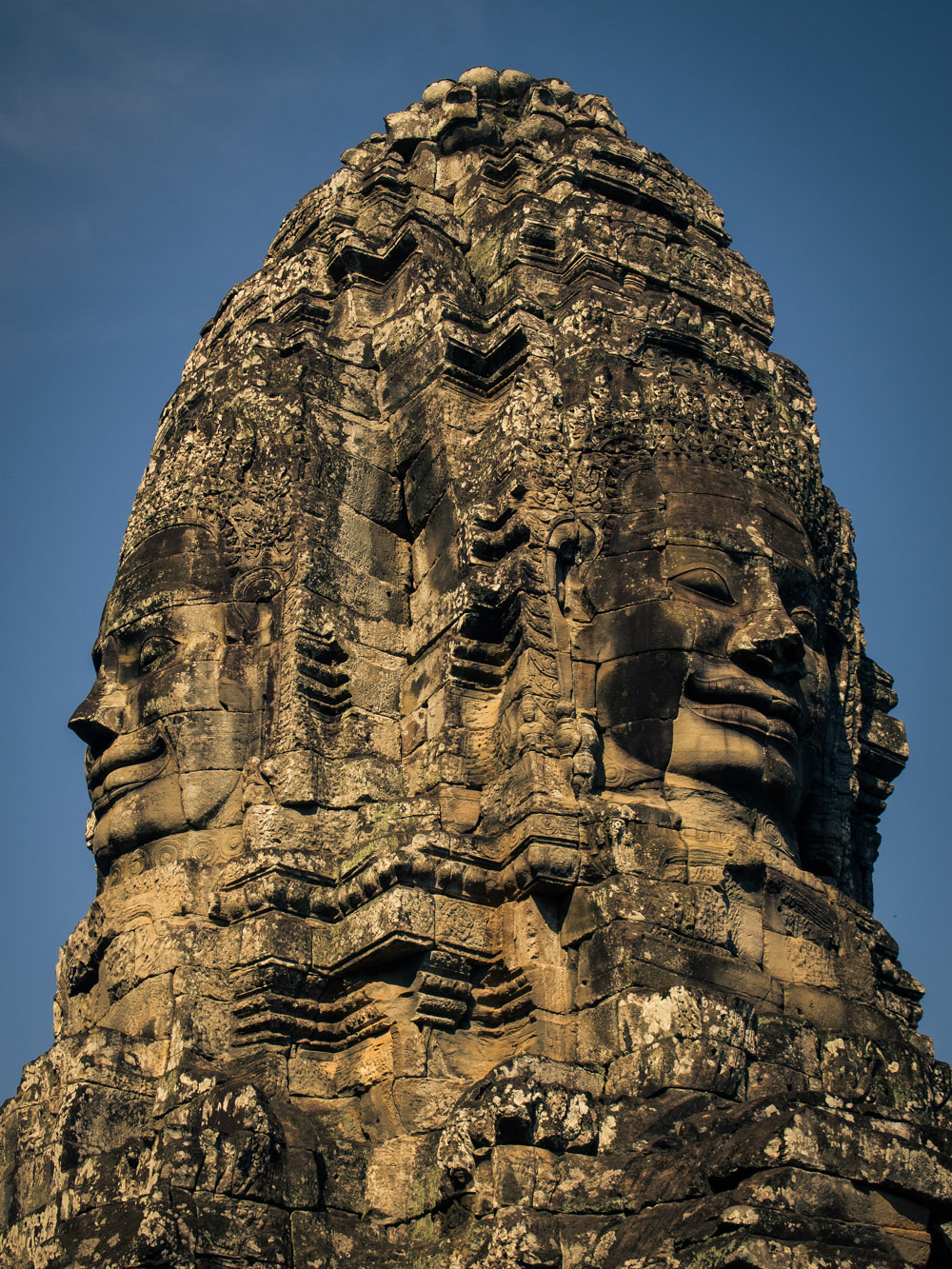
Angkor had once been sacked ruthlessly by the Chams, predecessors of the modern Vietnamese, and so the most legendary of Khmer god-kings, Jayavarman VII, set about building a walled capital that would later be called home by nearly a million people and impervious to assault by a perimeter of thick walls and a moat.  The wall forms a perfect rectangle with a bridge on each side.  Either side of the gate is flanked by giants or demons, engaged in an eternal tug of war by their pulling of Naga, the multi-headed serpent.  With frightening authority, the top of each gate has four faces of the bodhisattva Avalokiteshvara (or even Jayavarman VII himself depending on who you consult), one pointed in each cardinal direction, with an ominously haunting hint of a smile – a smile with the captivating complexity of Mona Lisa’s but made somehow foreboding by its authority.


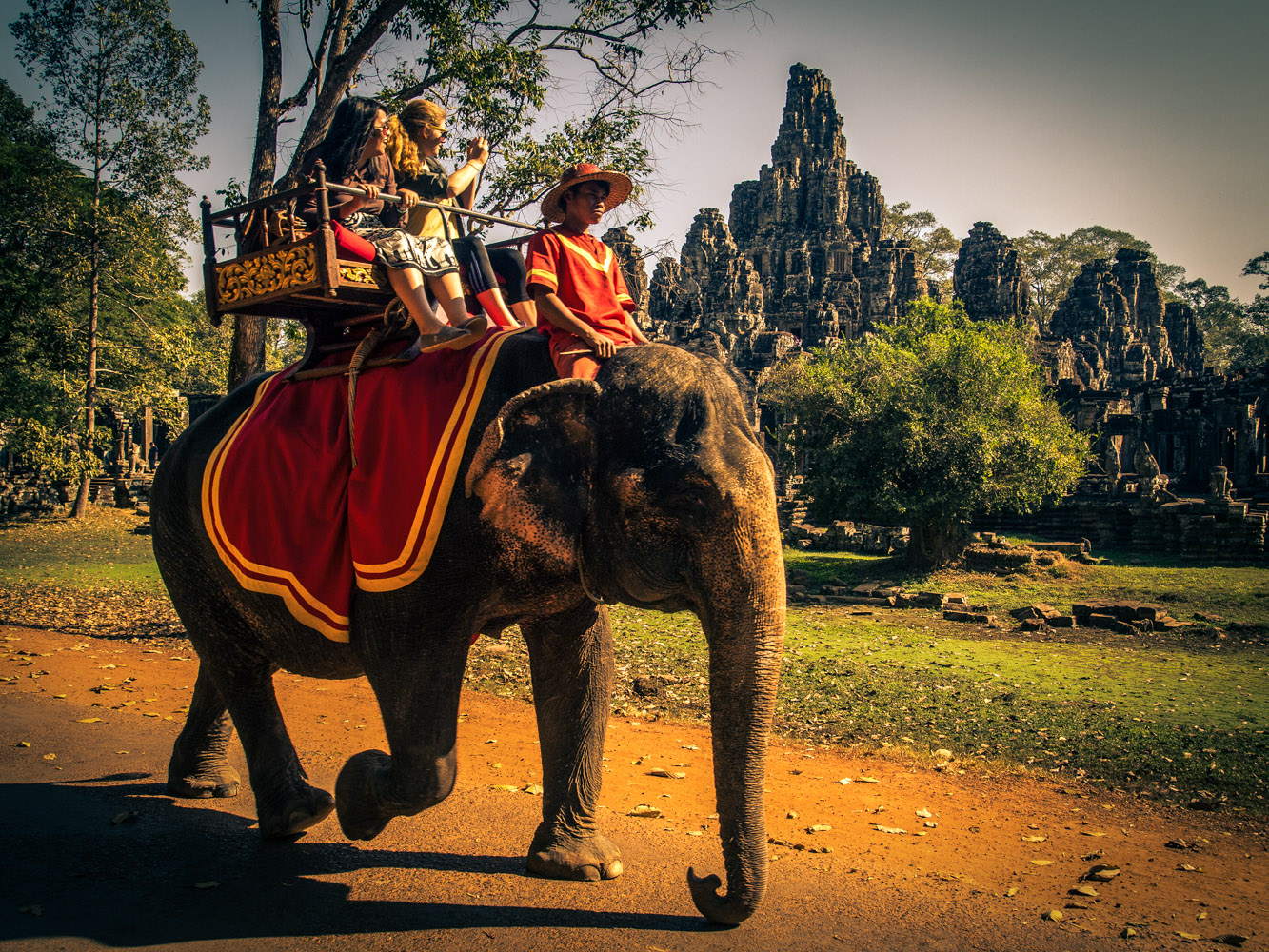
Once inside the walled city of Angkor Thom, you can follow the trumpeting elephants to the empire’s once beating heart, the state temple called Bayon.  Here the power of Avalokiteshvara’s face is made more powerful through repetition.  No fewer than 216 depictions of the same godly face adorn the stone towers, exuding an authority that must have terrified the god-king’s followers and commanded their obedience.


In four days Angkor kicked my butt and captured my heart.  The ruins there could be the most exciting in the world.  Cycling the paths in the spaces between sights was a pleasure alone, but left me craving complete immersion in the jungle, away from the paved roads.  And perhaps I’ll achieve that here in Thailand, as I’ve since spent a painful and boring 12 hours in the commute from Siem Reap to Bangkok.


Friday, February 15, 2013

Battambang

Strolling up and down Battambang, you’d never guess it was a country’s second biggest city; if it weren’t for the endless parade of motorcycles you could even call the place sleepy.  Still under the spell of their one time French rulers, you can buy baguettes under French colonial facades, and enjoy them on the street while passing French restaurants and crumbling écoles.

As it was with Phnom Penh, the city’s heart lies thumping in its darkly deco central market, a veritable gallery of curiosities for the westerner and perfect for window shopping.  Bright and spikey fruits of every size lay segregated from tiny firm purple tomatoes.  In another bucket, inverted green cones on stalks show off deep pores full of some kind of legume perhaps.  Pyramidal stacks of slimy pink gore await their buyers, and nearly dead fish suffocate slowly below a wire net, to prevent the occasional escape attempt (I had earlier seen a fish leap two meters horizontally in a futile attempt at escape).  You can scoop up pirated Xbox 360 games for two dollar USD.  Dental floss is going to cost you quite a bit more than that.

With most of my last week spent in silent transit, I didn’t realize how starved I was for proper conversation until I was invited to sit down and chat by a table full of monks at Wat Damrey Sar monastery (Asians beckon with a slightly erected arm and a flapping wrist in a gesture that looks quite like a western “shoo”).

I’ve found myself adopting local gestures – single souvenirs from each of my destinations.  I still find myself employing the Indian head wobble, a side to side wiggle to demonstrate unsureness, indifference, agreement, pacifism … whatever you want it to mean really.  In Nepal I adopted their specific gesture for conveying “no,” a flat palm perpendicular to ground the ground and twisted back and forth as if trying to adjust a watch.  In Burma, I’ve taken to giving and accepting money and goods the polite way, with my right hand only, and with my left hand tucked below my right elbow.  …and in Cambodia now, the beckoning shoo.

I spent nearly two hours in the monastery, speaking to a rotation of monks as they came and went form their monastic duties.  Topics of conversation happened to be dinner table taboos: sex, politics, and religion.  The recent U.S. election and the Cambodian genocide.  The principles of American and Cambodian courtship and marriage.  Cambodians seem to have a great fascination with the love triangle – nearly every music video I’d seen so far featured a left out would-be lover or two romantic partners vying for the attention of the third.  I ended up using the back and margins of my city map as scratch paper, drawing graphs to help illustrate my points where language failed, and interesting parallels ended up bridging the topics.  Graphs of the three branches of American government looked a lot like graphs of love triangles, and everything seemed to boil down to a discussion and analysis of incentives, greed, and altruism, the basic economic forces that govern everything about humans.


While Tibetan monks were required to play instruments and I had seen fit Burmese monks kicking about in a football field, Cambodian monks seem quite a bit more ascetic and are required to abstain from both music and sport.  They don’t, however, have to abstain from eating bugs, and as we were chatting they munched merrily away at fried crickets and chilies that they had purchased from women carrying great mounds of the insects on flat woven baskets upon their heads.


In the past, I’ve heard westerners espouse the value of Buddhism as a philosophy instead of a religion, but really, no one seems to regard it here that way, and Buddhsim is just as kooky, superstitious, and dogmatic as anything else.  If it weren’t for the golden Buddha cross legged in the center of every monastery in Cambodia, you might assume you looking at a Hindu temple.  The great snake Naga hisses from the corner of every roof and handrail, his slithering body streaming in even curvatures upward until culminating in a sharp spine characteristic of much of the architecture here.  Monkey Hanumans and eagle Garudas spread their limbs valiantly from beams supporting the roof.  Dog-lion chinthe guard the monastery doors against evil spirits – distinctly Buddhist compared to the Hindu characters – but then cement gravestones etched in Chinese characters contribute dashes of Taoism and Confucianism to the mix.  Tiny monasteries on pedestals sit before every home and business and look as though built as places of worship for birds, but are in fact intended to house and appease wandering spirits, and every morning barefoot monks with tin pots in one hand and an umbrella in the other hit the streets collecting alms.  Even the most impoverished of the poor pour their earnings into the monastery’s coffers.

Owing perhaps to Cambodia’s more progressive nature, I’ve noticed a great deal more western expats here than anywhere else in Asia I’ve been: lots of multiracial couples and white people working in non-profit restaurants and speaking fluent Khmer.  So is it that I’ve been regarded with the least amount of curiosity from locals than anywhere else I’ve been, but whereas in India, the locals’ increased exposure to white people means increased likelihood of touts and scam artists, I’ve found the Cambodians to be terribly polite and exceptionally honest.  I’ve even seen quite a few transgendered ladies in my short time here, and they seem to be treated with fair indifference, rather than condemned the way they are in most countries or even the helpless gawking that happens in America.

It’s been much more difficult as a vegetarian in Cambodia; I don’t think there’s even a word for vegetarian in Khmer, so I’ve been mostly sticking to the more expensive tourist restaurants, where many even understand the concept of veganism.   I did find a local veg restaurant in Battambang where I would be the only whitey around, and it had some of the best noodles and dumplings I’ve had so far.  I’ve been going there twice a day.  It’s also harder to supplement meals by snacking here, because even many of the bagged snacks aren’t vegetarian – lots of chicken and prawn crisps – and if they are vegetarian, they’re usually terribly bland and nutritionally bankrupt. 

(Weeks after originally writing this, I realized I had frequently been eating bread buns topped with an innocuous looking brown fibery substance that I later discovered is called pork floss (eww eww eww eww eww))


Cambodians are awfully fond of gingham.  Colorful checked sashes called krama are an important part of the Cambodian wardrobe and heritage and they’ll be seen often worn as scarves, bundled up around the face like a turban, or wrapped around the waist.  I noticed them first in photos of Khmer Rogue soldiers and the awkward experience of thinking, “my that’s handsome,” when looking at genocidal murderers.

Every country seems to have their own variation on the rickshaw.  Here they’re called remorques and consist of a comfortable trailer with a decorative prow attached to a motorcycle.  It’s cheaper, however, to hop onto the back of a remorque-less bike, as I did on my last day in Battambang to inspect the sights of the city’s greater area.


Just getting to and from places proved to be just as pleasant as the destinations themselves.  The rich country side was very diverse in landscape and we zipped past bamboo jungles, palm fringed swamps, ponds with simply perfect lily flowers, and long dusty plains.  In villages of stilted shacks, I could see transparent discs of homemade rice paper drying in the sun and it must have been quite an auspicious day as we surely passed at least half a dozen weddings (in Cambodia, both bride and groom dress in red with cheesy haircuts that would be more appropriate for prom – come to think of it, most of the couples weren’t much older than prom age, so I guess I’ll let it fly).  Brief stops included a leather farm full of grumpy grey crocodiles and a long abandoned Pepsi plant.


A hilltop temple from the Angkor period was built of giant stone Jenga blocks and looked as if a sneeze could cause it to topple.  Despite its ruined state, it still summoned worshippers that would climb the 358 stone steps to prostrate themselves before Buddha.  Walking along algae coated ponds at the base of the hill had me disturbing long salamanders from their rest and caused them to dive synchronously into the water, creating momentary blue-black apertures in the green film resting on the water.


12 kilometers southwest of Battambang is Phonom Sampeau, a family of monasteries (atop a mountain of course).  The lush pathways running to the top overlook steep canyon drops and deep caverns, including one where Khmer Rouge cadres would bash their victims’ heads in before kicking them down the hole.  Steps now lead down to the bottom of this killing cave where a Buddha sits placidly next to a glass shrine interring the remains of the victims: a huge pile of skulls with fractures that have you wonder morbidly whether they were caused before or after their owners plummet to the bottom of the cave.


In the lovely late afternoon ruins of an abandoned train station, now trafficked with grazing cattle and playing children, I met a friendly couple from Brisbane decked out in khaki adventure gear.  We sat cross legged among the grass covered train tracks and swapped tales and introspections of travel until the sun set and cued us for dinner.


I dropped at least a few extra dollars to take a river cruise to my next destination instead of a bus.  In my imagination, the cruise was going to creep slowly up serpentine riverways with towering jungle growth leaning over the banks and cutting the rays of the sun into a billion dappling shards.  That the caws of bright parrots and howls of swinging gibbons would fill the air and that some point the boat driver was going to have to fire shots from his revolver to deter angry hippopotami from attacking the boat (a la Disney Land’s Jungle Cruise, if you don’t know, and yes, I know there aren’t hippopotami in Cambodia).  Well the extra cost didn’t end up buying me a pristine shooting location for a Vietnam War picture that I had drummed up in my head, but it did afford me white neighbors! (uncomfortably, the few Cambodians on board had to sit at the back of the boat)


While never quite jungle-y the way I was hoping, the river landscape was full of lovely birds and great slices of river bound rural life.  House boats both off and on the water housed napping Khmer, fishermen waded chest deep to adjust their conical fishing nets, and the daily passage of foreigners proved to be a highlight for the many naked children whose faces lit up upon our passing by, and their hands flew up vigorously in friendly waves.  I felt a little awful about our passing at times though.  The water in the river was so shallow that the momentum of our medium size vessel displaced so much water that it caused a mighty wake that wouldn’t surprise me if it occasionally capsized the villagers’ modest and narrow fishing boats.


Sunday, February 10, 2013

Phnom Penh


I don’t know how apparent it’s been in my writing so far, but I think there’s been a gradual leaning toward bitterness and cynicism.  I’ve been finding myself subject to increasingly frequent mood swings, and alternating between euphoric wonder and a motivationless malaise that has me wondering “what the hell am I doing here?”  I set myself a very tight budget that I can’t stray too far from, and the cumulative discomfort and overspending of weeks before had taken a considerable toll on my spirit of adventure and I took my first steps in Cambodia more than ever missing New York, my friends and family, and my domestic life.  I hadn’t seen a familiar face in about three months.  This wasn’t the first time I had felt this way, but this time I caught myself, realizing how I had first felt the same listlessness and dismay when I had first arrived in New Delhi, Kathmandu, and Yangon.  I’m still working out the reasons, but for some reason my first moments in each country I’ve landed in so far have been characterized by aimlessness, confusion, and disappointment, but each time the places had grown on me to the point of fondness.  It takes time, but I think it is time that helps me answer that initial question, and I get to discover what the hell it is I’m doing here.  Discovering this pattern helped pick up my pace in Phnom Penh, and I then better looked forward to seeing what Cambodia had to share.

Perhaps the biggest difference I noticed about Cambodia in comparison to my other destinations was the amount of exposed skin you can see on the street.  India, Nepal, and Burma are all very conservative in this regard, and I fear I had adopted some of their biases: the first girls I saw wearing makeup and displaying cleavage I had simply assumed were prostitutes.  After only two months of seeing nothing but conservative dress I found myself gawking at the immodesty of shorts – white and brown people with exposed thighs! – but soon got over myself enough to take a knife to my khakis so I could better escape the southern heat along with my newly adopted prejudices and join the fray.


This tour has been very illuminating for my sense of classical Asian aesthetic and I’ve found it very pleasing to witness the subtle evolutions of art and architecture as I plod my way farther eastward, and train my eyes to look for the Indian in Nepal, Burmese in Cambodia, and so on.  The fiery and jagged edges that fringe the roof edges of Burmese monasteries have smoothed out to the wavy lines contours of long snakes, and culminate on either end with hooked tail tips or the many heads of the snake god Naga.  Likewise the gradual variations of lines and shapes that subtly alter as I change geography can also be seen in the curvatures and skin tones of the faces of people on the streets. 

The National Museum in Phnom Penh is full of ancient and beautiful sculptures of my friends Vishnu, Buddha, and Ganesh, but in variations particular to the region and artisans of the Khmer empire (like in Burma, Hinduism eventually lost all traction to Theravada Buddhism, but elements still remain; Hindu animal gods like Hanuman, Garuda, and Naga are heavily featured in Cambodian Buddhist monasteries).  Much of the art in the museum is from the Angkor Wat complex to the northwest and the grace and power of these particular pieces made my anticipation of actually being in Angkor Wat build to a frenzy.


The money situation in Cambodia is a little peculiar – prices are often listed in U.S. Dollars, and in fact most ATMs spit out USD, but when you spend the dollars, you get back Cambodian Riel as change.  1000 Riel notes act basically as quarters.  It’s disorienting at first but works out quite effortlessly when you get the hang of it.


I had a super time when I was exploring the downtown area by the banks of the river, when the thong my cheap Indian sandals snapped at the toes, leaving me barefoot like the umbrella wielding monks collecting alms in the morning.  My frustration slowly melted away when I discovered how oddly soothing the gristle of asphalt and edges of tile work felt as they penetrated my sore and calloused soles (I’m having trouble figuring out how cheap Cambodia is: my 10 kilometer moto ride from the airport was only $1.25, but I’m having a tricky time finding replacement sandals for less than $10 (I paid only $1 for the pair from India)). 

There’s nothing like actually being in a place to help dispel your ignorance about it – before stepping foot in the country I knew precisely jack about Cambodia – and I now have a proper appreciation of just how big of a douchebag Pol Pot was.  Around two million Cambodian lives were lost tragically to genocide when this monumentally terrible douchebag led the Khmer Rouge to power.  He expelled all city dwellers to internment camps in the country and almost overnight Phnom Penh was a ghost town.  Despite this mind-numbingly horrible no-good crown prince of douchebags’s education and qualifications as an educator, educators were among the first to go, as the party was trying to create an anti-intellectual rural society as quickly as possible.  Knowing a foreign language was grounds enough for imprisonment and subsequent execution.  “Better to kill an innocent by mistake than to spare an enemy by mistake,” he said while fueling the insane paranoia that was pervasive in those days and caused so much suffering and pointless death. 

I learned all this first at Tuol Sleng, a former high school that was converted into a prison by the Khmer Rouge.  Of the thousands imprisoned there – as many as 20,000 – all but seven were executed, and the typical two to four months they spent there were utter hell.  The place still stinks of despair.  Blackboards and teachers’ desks still remain as they were, however, they lay next to iron shackles and crude instruments of torture.  Classrooms were converted into tiny cell blocks of shoddy wood or brick construction.  Occasional photos mounted on the walls display the shocking state of things when Vietnamese troops arrived: emaciated corpses shackled by the ankles and broken from physical abuse.  One man was beaten so badly, the white of his skull shone through open gashes on his face.  The Khmer Rouge kept meticulous records of those they interred and many of the classrooms are now lined with photographs of the faces of those lost so tragically.  I kept my composure until nearly the end of my visit, but upon learning just how few even survived this place, I could do little else than bury my face in my hands.


The killing was rarely done at the school, but rather in a field 13 kilometers southwest of the city.  The victims were usually under the pretense that they were being relocated to a nicer facility so as to maintain their compliance.  Instead they were blind folded, knelt over an open ditch, and bludgeoned from behind.  Bullets were too costly to waste on so many victims so the executioners elected to use hatchets, garden hoes, whatever they could get their hands on.  There are reports that throats were sometimes slit with the serrated edges of palm fronds growing on the grounds.  To the touch, they felt more than capable of the task.  Some 9,000 victims were unearthed from this site alone.  There are dozens like it across the country.  Human fragments still surface occasionally, usually after a rain.


The women’s bodies were usually recovered naked.  Raped of course.  The most horrifying sight there (mom, you should probably skip to the next paragraph), has been named the killing tree.  Here infants were executed.  They were gripped by the legs and bashed against the tree.  Today it’s covered with ribbons and bracelets left by visitors.

The killing fields today are a surprisingly serene place, full of green gardens and butterflies.  The loveliness of a tree lined lake almost seems to contradict the fact that it is still full of the skeletal remains of murdered innocents.  A central pagoda commiserates the dead and houses their recovered remains in glass tiers separated by the type of bone.  A few layers for skulls.  A few for leg and arm bones.  Hips and shoulder blades and so on.  A towering and sorted stack of skeletons.


Incredibly, despite the atrocities, the Khmer Rouge were earned a seat at the United Nations, and only 30 years after these crimes were committed were the leaders ever arrested.  Pol Pot was never prosecuted, having died at the age of 72, and Cambodians are still waiting for justice to be carried out upon the remaining ringleaders.

Monday, February 4, 2013

Sleepless Nights

Monks collecting rice in Mandalay's early morning

Okay, Bagan wasn’t precisely my last location in Burma.  I had half a day left back in Mandalay, so I took a slow boat up the Ayeyarwady to Mingun, a riverside town with some epic feats of architecture.  A huge plateau just past the banks had been magically carved into a cubic temple with steps leading to Buddha enclosed shrines on each of its four sides.  Burma is subject to earthquakes, occasionally of great proportion, and quakes past had inflicted mighty scars in the plateau – beautifully terrifying rifts now filled with shadows and gentle yellow grasses.


The world’s largest uncracked bell is a short stroll upriver, and a two foot measure of tree trunk leaned nearby invites you to make it the one time world’s largest uncracked bell with a satisfying bash that sends noticeable vibrations through the air.  Further upstream is a lovely white temple and a beautiful exercise in repetition and symmetry, with identical archways cascading down the steps from its peak. 


All in all it was a nice day breaking up the monotony of a long and painful commute.


An overnight bus took me to Mandalay and another one awaited me there for my return to Yangon.  Already the first nighttime commute had worked curses into my buttocks and I dreaded spending yet another night of sleeplessness sitting upright.


In Yangon, and to my amazed frustration, I relived my awful experience of trying to get to the airport I suffered in Kuala Lumpur.  A bus conductor at the second bus station in Yangon (I had to take a bus from my bus to get to my bus) assured me his bus went to the airport, and I double checked with the driver that we were indeed going to the airport.  Just like last time, I sat patiently next to the window until my face slowly began to wear an expression of, “where the hell are we going and what’s taking so long” that became cause for the passenger next to me to ask what’s wrong and if he could help.  I pulled out a map and he showed me that we were in fact going in the opposite direction of the airport.  I got up and had them stop the bus.  I was so strung out and I wanted to curse at the driver so badly, but did my best to contain myself.  Asians don’t react well to foreigners losing their cool.  I don’t know if the conductor and the driver in both instances were trying to con me, if out of a sheepish desire to be agreeable they just said the bus was going where I wanted, or what, but whatever it was almost cost me hundreds of dollars, and again, I searched frantically for a cab that would take me on a nervous ride back to the airport.  Somehow instead of finding zen in Asia, I’ve found myself slowly becoming less patient and more readily stressed out – I’m finding myself getting pissed off at little things and having cruel and petty thoughts that are completely out of character for me.  I think the cumulative discomforts I’ve endured in the name of saving money have been slowly chipping away at me and leaving me more sensitive to the rigorous parts of traveling.  I’m not a superstitious person in the slightest, but I’ve found myself clinging to the pendant I bought in Nepal.  It’s etched with the Om mantra, but I can’t read Sanskrit, nor do I remember what the mantra is, but somehow I’ve replaced the syllables of the mantra in my head with Samuel L. Jackson’s character in Pulp Fiction commanding, “bitch, be cool,” which seems to have the same basic function and desired calming effect on me.  Making a small mental effort to mellow out is starting to help me cope with the more stressful situations and I want to keep developing tricks to rebuild my psychological defenses.

Once again, I had an overnight connection in Kuala Lumpur before flying to my ultimate destination, and when I was checking my bag and asked if I wanted to pick it up in Malaysia or have it forwarded to Cambodia, I decided right then I was going to be a bum and find a way to sleep in the airport.  The sweet lady taking departure cards then wished me a happy new year, and I realized I had forgotten to give the guy next to me on the bus a midnight smooch – but I guess I was sleeping (or at least trying to sleep) at the time anyway.

Internet access in Burma was utter rubbish and I looked forward to catching up with my interweb business in the airport, but later found that during one of my overnight busses I had accidentally left my electrical adapter, and like fun was I going to spend $15 on one at the airport when I could get it for a dollar in Phnom Penh, so I had to get creative about staving off boredom for 17 hours in the airport.  I walked clockwise first through the entirety of the main and auxiliary terminals, being as thorough as I possible in my scrutinization of each of the duty free shops.   I felt the vanity I had learned in New York and was hoping to unlearn in Asia seep back into me as I perused beautiful Italian shoes, absurdly expensive watches, the newest versions of my camera, and fine bottles of scotch.  Without discipline, the cost of airport food could have easily outdone my attempts at saving money on boarding and transit, but I was fairly scrupulous with my dollars and the Malaysian Ringgits I received in change.  Out of curiosity, I had to try a blended drink made from soy milk, red beans, and cendol, weird strands of slimy noodles I would later learn are made from sweetened pea flour.  Somehow the airport roti I used to take down a bowl of Malaysian curry was the best roti I’ve ever tasted.

Cleverly, the auxillary terminal is a large circle with a tiny bit of rainforest jungle embedded in an open air enclosure in the middle.  After a pair of automatic doors you leave the air conditioned coolness of the terminal and get treated to warm jungle humidity, the pleasant sounds of birds, a manmade waterfall, and verdant vines, trunks, and palms.  Plaques on the foot path tell you about each tree’s geographic distributions in Malaysia, typical height, and uses in industry.  It whetted my appetite for true jungle adventure and made me terribly excited about the days to come. 


Around 10:30 in the p.m. I went to a dimly lit terminal I had scouted ahead and snuggled into a row of benches facing away from the corridor, hoping their positioning would buy me some privacy and protect me from the scrutiny of security.  Worry, though, kept me from sleeping and turned every footstep I heard into that of a guard’s telling me I had to go.  At three in the morning, it happened.  A guard tapped me on the foot …  but to my relief, I found the room had since filled up with other vagrant sleepers and he was merely asking us to relocate so they could give the room its routine cleaning.

Ninety minutes before my flight I shook out as much of the fatigue of three nights without a bed or shower as I could, took breakfast, and boarded my flight to Cambodia.

Sunday, February 3, 2013

Bagan


From my vantage point, perched on a high corner atop a pyramidal temple, scaled with steps steeper than they are long, I could watch the sun sink into the mountains over the Ayeyarwady River, Burma’s largest and most vital waterway.  Evening mist from the river and dust kicked up from the dirt roads mingle together and float low through the valley, lapping at the feet of giants: innumerable temples of every size and shape, but in mutual solidarity in their composition, made from dry red bricks and worn down by the centuries to austerity.  In every direction, the line of the horizon is pierced by sky reaching spires, mesmerizing in their repetition.  Any one of these mammoth monuments could be the proud emblem of any city, but here in Bagan even great temples are in such supply that many aren’t even afforded symbols on a map; it’s as if a whole nation was rearranging its furniture and had consolidated its architectural treasures in one place for inventory.  I’ve seen this sight before, months ago, but this vision had faded from memory until I had taken my seat on the temple ledge.  It was a double page spread depicting the Bagan sunset in a travel magazine, and I was so captivated by what I saw I knew I was going to be there even before I read any of the words or even understood what I was looking at or where it was. 


The vantages from the magazine, however, were from a considerably higher vantage point; from the basket of a hot air balloon that I couldn’t wait to take myself … until I found out I’d have to shell out $250 for the privilege.

Much like my searching in Inle Lake, it took me at least 90 minutes before I could find a room with even a vacancy, but my health was better this time and I was better able to keep despair at a manageable distance, despite being so repeatedly turned away.  The room I finally found only cost me eight dollars.  A Chinese backpacker I had met on the overnight train spent over two hours on her hunt and inconsolably settled on a room she found for forty.  It was all the more discouraging for me that my hunt was hindered by the deceit of a trishaw driver.  When I was about to cross the line in the tourist village of Nyaung U where the hotels began to have vacancies, he told me that there weren’t any hotels in that direction.  He had been tailing me for a few blocks hoping I’d give up my hunt to become a fare and let myself be taken to an overpriced hotel where he could fleece me for a couple extra dollars as a kickback, and his lie cost me the better part of a sweaty hour and some of the faith I had invested in the Burmese.  The cynicism I forged in India had to come back, and it saddened me to apply it to the people here, who had been nothing but warm, almost excessively friendly, before I arrived at their most tourist drawing treasure, but tourism begets scam artistry and I then braced myself for the possibility of scams and the certainty of obnoxious souvenir hawkers (no, I didn’t want any lacquerware from the sixty three other vendors who assailed me in the last two hours, and I don’t want any from you, sorry).

You might have noticed I switched to referring to the country as Burma.  While I like the progressive quality of non-ethnicity specific Myanmar I’ve found Burmese dissidents are reluctant to use the government mandated moniker, and I’ve decided that until the Republic of the Union of Myanmar is indeed a republic and the people are led by the elected, I’m going to stick to Burma myself.


Exploring the imposing facades and deep Buddha dwelling caverns of Bagan’s great temples was a unique thrill, but it required more effort than I had been anticipating.  The 42 square kilometers of Bagan’s cultural zone are networked mostly by unpaved dirt trails navigated most typically by taxi, horse buggy, or bicycle.  Foreigners are forbidden from renting motorbikes.  Hoping to relive the independent exploration I enjoyed in Hampi, and unable to afford drivers all on my own, bicycle was the most obvious and practical option for me.  But the bicycle proved to bring along its own impositions.  The dirt paths were alternately rocky and then so sandy the wheels would sink too deep for pedaling, conditions that required constant dismounting and plowing through the sand on foot.  This made the thickening heat unbearable and the comfort I briefly enjoyed from cool breezes against my shirtless skin was replaced by the sharp mandibles of giant flies.  And as soon as I reached the farthest point I had hoped to reach on my first day, planning to then about face and enjoy the sights on the way back to the hotel with the sun at my back, I stepped right onto the sharp point of a narrow hacked down tree.  In seeming slow motion I could feel the probing tendril peel through the plastic of my sandal, feeling exaggerated and cartoon like as if piercing a second husk-like and nerveless elephant hide, before the momentum of my step and gravity pulled my actual flesh into and around the twig.  Grumbling curses while tumbling onto my ass, I MacGyvered a bandage from toilet paper and tape and limped through the next few temple grounds until the pain numbed.

By the time I had creaked into the temple where I’d enjoy my first sunset, a flat wheel had made bicycling nearly impossible, and I was counting on having to lug the damn thing to the nearby resort village and hope I could throw it in the back of a pickup headed for Nyaung U.  I was spared the effort ultimately, because somehow during the sunset (which was gorgeous), I had lost the key to the bicycle’s lock, and after a pathetic and empty handed search I found myself laughing at my bad luck and ineptitude and how perfectly stupid my geographic progress had been that day.  Good fortune saved me unexpectedly when I heard an excited “Matthew!” from behind me in the parking lot.  The pair of families that had adopted me in Yangon were bundled into a large van in departure from their own sunset, and after hearty pleading with the nearly resolute driver, we convinced him to let me wiggle the bicycle and myself into the van.  I was brought back to my hotel where I paid a very fair fee for the lost key, and after tipping the driver who was very tickled by my measly three dollars, all was right.  I joined the families for dinner where we swapped Burmese war stories of navigational and intestinal woes we had suffered since Yangon.


I wish I could say that’s where by bicycle issues ended, but the next day I found myself once again far away from home, but this time with two flats.  Deflated myself, I whimpered into a village where a young woman immediately noticed how crippled my bike was and led me behind a barn where a thick armed Burmese woman attempted to fix them.  I leaned on a wooden porch, looked lazily about my rural setting, and joined in listless chatter in the limited English my temporary hosts knew.  Humped white cows chewed on cud and little boys watched a Korean soap opera on the television inside their shack.  Another woman led in a curious young Chinese tourist, showing him how to spin cotton and weave fabric.  An 86 year old grandmother came out to the porch to suck on a truly gigantic cigar made form a corn husk, one of the two she’s enjoyed every day for decades.  I left just in time for the next day’s sunset, but of course just as soon as I had departed from the village the front wheel went flat again and simultaneously the steering bars went limp from the front wheel, making turning even slightly a difficult and even dangerous thing to do.  With some trial, error, and copious sweat, I discovered I could still plod along if I hunched over and held the bicycle’s mounted basket in place, which would keep the wheel steady while I nurtured the brake with my other arm.  By the day’s end, I probably spent between three and four hours en route to a place I wouldn’t find or just plain lost.


In a shady courtyard, I happened upon a young girl next to a shrine, a circle of cross legged Buddhas around a tree.  They were seven in number and behind them was a trough of water.  The little girl was on the tips of her toes scooping cups full of water and pouring them on one of the golden Buddhas, again and again.  I had read about this; Burmese astrology is based not on the month or year you are born, but rather the day of the week.  I’m not sure what the aim of the ritual is, but one is supposed to wash the Buddha once for every year they’ve been alive, and then once more for good luck.  Watching her pour down on Buddha got me so curious as to the day of the week I was born was.  It then occurred to me there was a calendar on my iPod and I got to clicking back in time to find the April from 25 years ago.  308 times I clicked the back button on the iPod’s wheel until I finally arrived to the day of my birth … which happened to be a Wednesday.  The Buddhas around the tree were invitingly marked in English as well as Burmese, and before getting back onto my bike to continue exploring I drowned my Buddha 26 times.  For good luck.

The temples of Bagan were as awesome as they were numerous, and all the more so in the photographer’s golden hour.  As old as they are, there are even a few remaining nods to ancient Burmese Hindu worship, as the temples were built before all Hinduism was all squashed out by Theravada Buddhism – and learning this gave me an unexpected thrill.  It seems India and Hinduism has taken a lingering hold on me and I was terribly excited to find three headed Brahmas etched into some of the walls in this land of Buddhas.

On the way to the Hindu temple, I bumped into a trio of men who worked for the zone’s conservation team as they were conducting a survey.  Pleased by my curiosity, the leader of the three would include me by repeating some of his conversation in English.  Some of the temples have lovely but badly scarred murals running from top to bottom of the temple’s interiors.  To battle deterioration many murals had decades ago been hastily and unattractively covered up in white stucco that was now slowly being revealed and preserved by professional restoration crews.  The restoration efforts have been guided by Indian consultants with decades of experience in monument preservation.  Restoration project were occurring everywhere in the cultural zone, in and outside the temples.  Roads were being built and many of the courtyards were crawling with workers building walking paths and planting gardens, and will one day show off the benefits of beautification.  Bagan is truly the jewel in Burma’s crown, and now that the doors have been widened to the world, the government is investing in it with great effort.

Lady monks wear pink because they are girls, duh
I saved Bagan for last, the climactic event of my excursion into Burma, and it very much cemented my relationship with the country.  Burma’s full of wonder, but it’s somehow always been just a little out of reach.  I felt somewhat excluded and constantly beset with obstacles.  In many ways Burma works against the backpacker, especially one going it alone.  The scarcity of permits granted by the government to hotels and the steep amount the government skims from hotel transactions diminishes the incentive for new hoteliers to create budget accommodations, and the disproportionate amount of tourists to the availability of rooms drives prices up well beyond reason.  The state of public transit is atrociously inefficient and difficult to navigate.  Most bus stations, train stations, and airports are an absurd distance from city centers and each other, and there are rarely direct connections to and from any of these, making taxis almost requisite for the traveler.  The numbering on busses and trains is usually in Burmese and getting straight directions from anyone is a challenge in itself.  Foreigners aren’t permitted to rent cars or scooters either.  The cash situation, as I had earlier described, is absurd and can be utterly frustrating.  Now that I’ve hit the biggest sights on the main tourist circuit, I’m left feeling that anything I might want to do in Burma, I could probably do elsewhere for less, and while India and Nepal had left hooks in me ensuring my return, I wonder if Burma and I will soon or ever meet again – which is a shame, particularly because the people are perhaps the warmest and most accommodating I’ve ever met.


Addendum since penning this entry:

My blog posts are now about a month behind my journaling and actual experiences – time for editing photos and transcribing and editing text is fairly scarce on the road, but I’m making an effort to keep anyone interested in the know.  I’ve since spent some time in Cambodia and Thailand, and can say Burma’s not really any more (or at least much more) expensive than any of the other countries in the region – I was just dismayed with costs after spending so much time in dirt cheap Indian and Nepal.  My troubles with traveling in Burma remain grievances, but were certainly exacerbated by the fact that I went during their two busiest tourist weeks of the year, during westerners’ winter break.  I highly recommend visiting Burma, but not without researching the heck out of it first, getting away from the tourist circuit, and I think the getting around would be easier with a partner.