Sunday, January 20, 2013

Stuck in Yangon


I was hoping for a quick in-and-out situation when I had returned to Yangon – take care of a few errands and be on the first bus upcountry – but all the buses were booked solid.  The third travel agency I visited was able to save me the one seat on the one bus they had left for the end of the next day.  I felt thoroughly finished with Yangon and eager to move on, yet I was stuck and the feeling of immobilization made me clench my teeth with frustration.  A mere consolation, this gave me some time to be productive and I gave myself a to-do list to pass the time, and a couple of off days probably wouldn’t be bad for my pathetically optimistic budget.


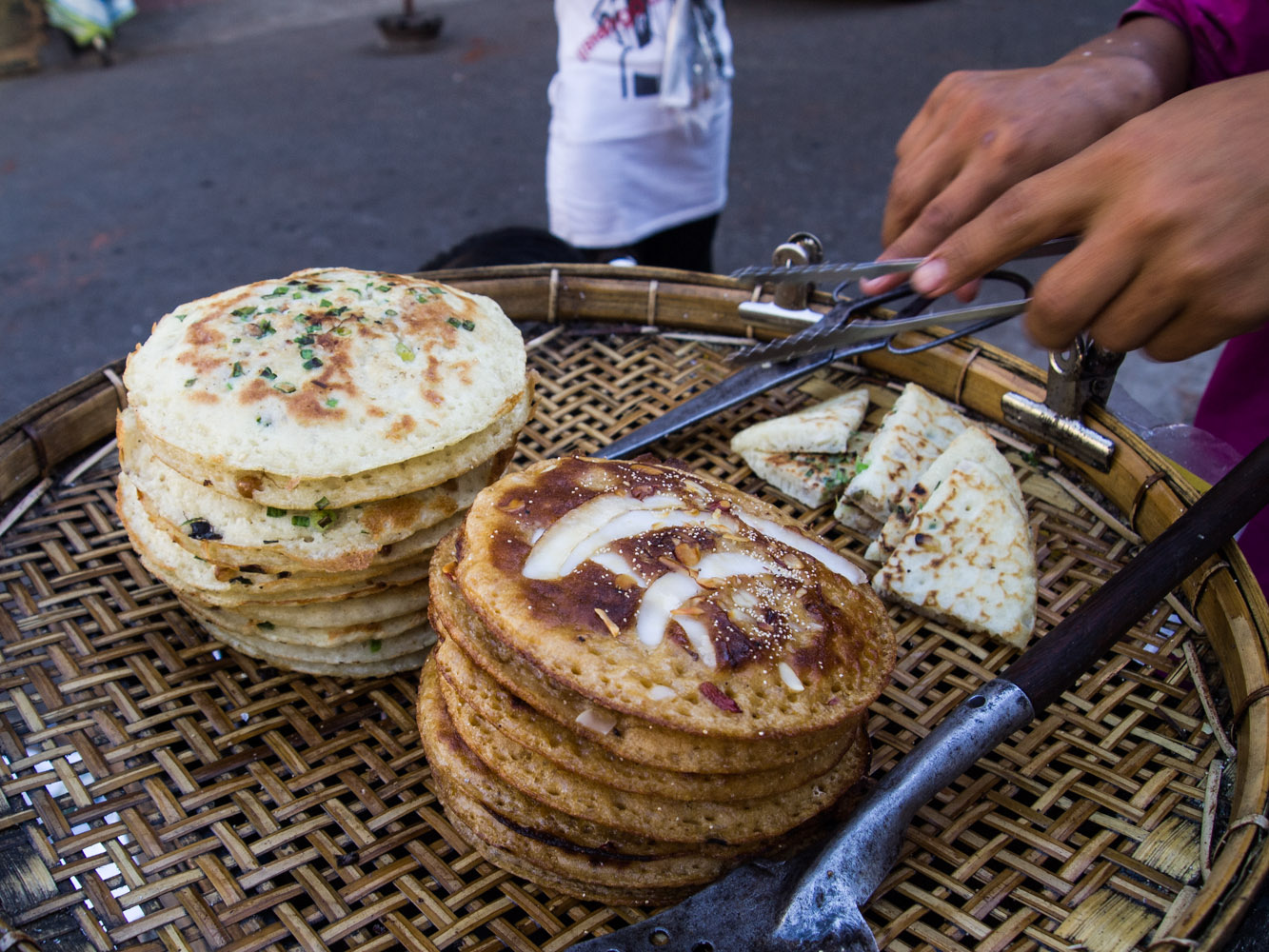
Freed from the duties of the sightseer, my pace had a deliberate slowness to it that I hadn’t felt in some time, and I was better able to soak in the city’s atmosphere and get closer to its people.  Very quickly my temperament changed from bored anguish to curious contentment as I watched monk boys thumb through sidewalk racks of pirated DVDs and I helped myself to Myanmar’s devilishly good street food.  With an appetite that’s becoming increasingly difficult to suppress, I have become terribly fond of Burmese pancakes – served either savory with nuts and green onions or sweet with thick slabs of coconuts.  After stuffing my face with pancakes I stopped at a noodle stand to wash it all down with Chinese green tea.  Here, mealtimes are spent at tightly packed sidewalk stalls sitting on tiny pastel colored plastic furniture I would normally think is built for children.  After downing my third cup of tea, I took my secondary wad of cash out from my chest pocket (I’ve started keep my large and small denominations separate – it helps my bargaining power in getting change when I need it (It can be terribly difficult to have change made, so I keep my sanity by making a game of it)), but the sweet guys there refused any payment.  Again, I’m having a hard time getting people to take my money – though the reasons this time are infinitely more pleasant.


I then proceeded to play a game; let’s call it hot & cold charades.  I would stop someone on the street with a friendly “Mingalaba”, take off my hat, pantomime cutting my hair with scissors, and point in a wild circle with a confused look on my face.  After a few rounds of the game I found myself getting closer and closer until a group of gentlemen playing that popular sidewalk bottle cap game gestured for me to turn around, so that I could see the barbershop behind me.  No longer coping with Nepal’s chills, it was time to kiss my beard goodbye, so I drew up an illustration of what I was hoping to accomplish and handed the sheet to the wild haired young Burmese barber.  After double checking a couple of the finer points in my sketch, he then took electric trimmers to my face and glowing tufts of brown hair tumbled down to join the mess of black on the floor.  Finished, I stood up and whipped out my money clip.  Once more, a young man smiled and twisted an open palm in my direction.  He wasn’t going to take my money either.


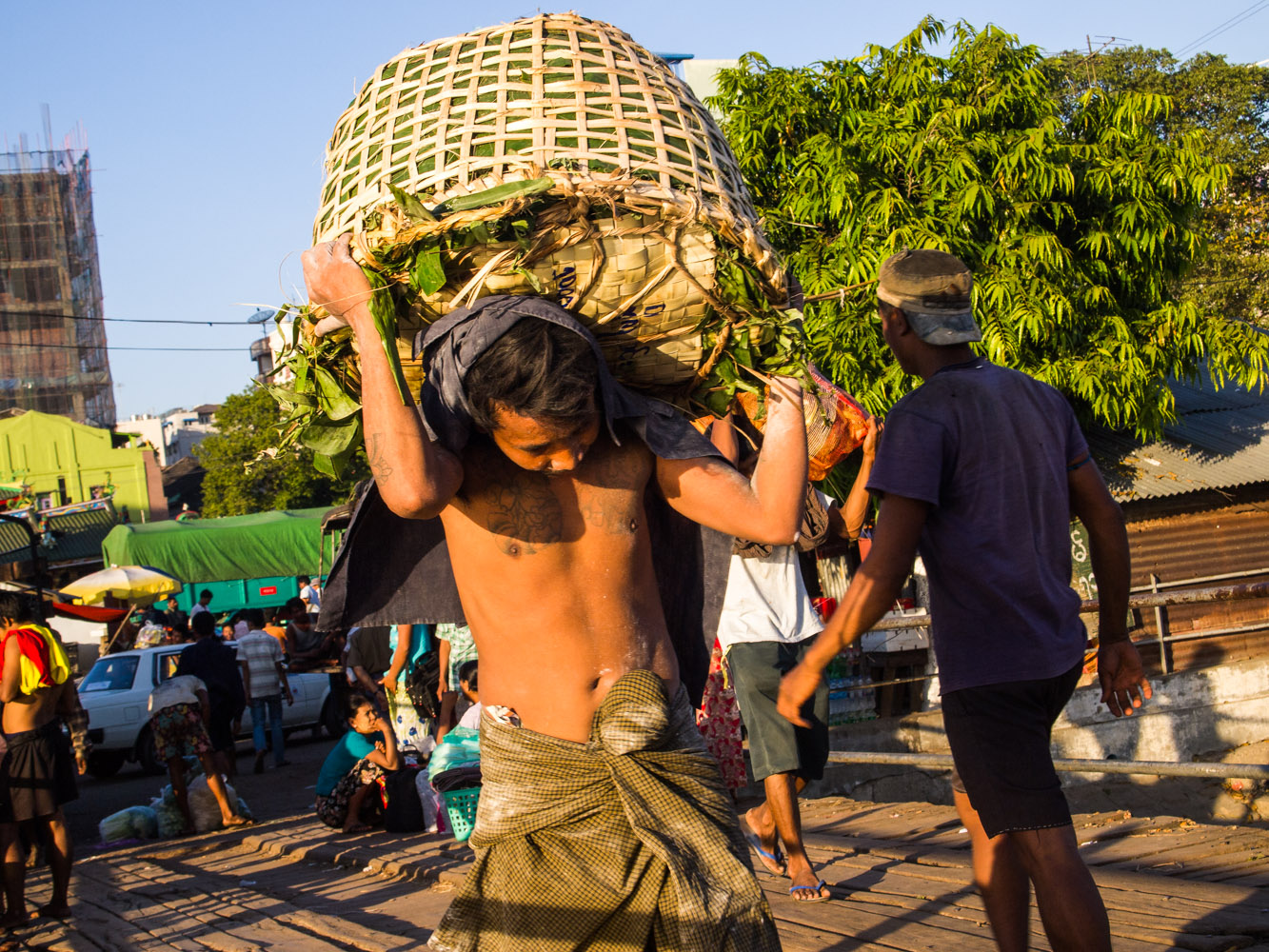
On a tip, I headed toward the Chinese temple by the river for sunset.  I crossed the street and took a vantage point along a long gangplank leading to a pair of three storied commuter boats.   The place was simply abuzz with activity: the city’s traders making their mass exodus back to their villages across and up the river.  I hugged the rails of the causeway to stay out of the way of streams of shirtless and tattooed workers hustling huge loads of pineapples, coconuts, and everything else in large bundles upon their hunched shoulders.  A thick layer of sweat made the lines of their sinewy muscles shine in the sinking sunlight.  Below the causeway long motorboats rushed in to meet the long lines of commuters waiting at the river bank, to take them to the other side.  Each motorboat was then tailed by a cloud of seagulls hoping to catch prawn chips and rice puff from villagers enjoying late afternoon snacks.


I decided to hop onto one of the larger cruisers to try a different perspective from the top decks, but just getting there proved to be a journey.  Every floor was so packed with people, goods, and livestock, every few meters of progress was a separate gauntlet to navigate and the very air was thicker with humidity than outside the boat.  The bustle outside couldn’t nearly match the clamor inside with tired traders noisily vying for comfortable and disappearing real estate and hawkers of every sort weaved through the crowds with nasally pitches hoping to make the day’s next sale.  I only added to the spectacle and was greeted with much amusement and perhaps a little annoyance for my trying to navigate the throng of their daily commute.  I got off the boat just as the deckhands were untying the mooring cables for departure, and then the sun was nearly at its climax.  Very soon, the whole world was depicted in graceful black silhouettes basking in a golden solar luminescence, textured with the smoke of motors and the white ripples of the river.  It was wonderful as I stood on the bank delighting in the beautiful minutiae of other peoples’ lives, and I kept my finger hot on the shutter button the whole time.

Wednesday, January 16, 2013

Bago


“Ee,” the sweet lady at the San Francisco hotel in Bago, creaked open a dubious smile as she divulged to me the secrets of how to see all of Bago’s great sights without paying the hefty government entrance fee.  With the city map laid out on the reception desk, she showed me which entrances would permit me to skirt around ticket checkers or when to arrive so I show up before or after they do.  While the government’s made some strides in favor of its people over the last decade, it still has a long way to go before it earn its people’s respect, and Ee and I both were happy to give them the finger by cheating them out of admission costs.


On a rented bicycle, I raced ahead of the ticket checkers to the Shwethalyang Buddha, a cheerful Buddha laid on his side, partially perched on an arm.  The soles of his feet are absurdly ornate, but most remarkable about him is the fact that he’s 55 meters long.  His little finger is 3.05 meters long and his upwardly curved lips run 2.29 meters across.  A slightly smaller replica sits outdoors to the south.


I got lost somewhere near the Bago River and let myself into a monastery to look around.  A kindly monk by the name of Ottama invited me to sit with him and we talked at length of the political and spiritual state of his country.  He showed me clips on his smart phone of Obama’s recent visit to Myanmar, greeted by Myanmar’s champion for democracy Aung San Suu Kyi.  Ottama walked me through some of the Burmese pleasantries I hadn’t picked up yet (a few of my mental tricks are Yao Ming Ali Baba for hello and Jay-Z Ding Bat Day for thank you).  After he scribed in curvy Burmese characters the word for vegetarian, he insisted that I join the monks for their daily lunch and my face was promptly stuffed with rice, peanuts, corn, okra, and this lovely salad made from tomatoes, green onions, and crispy sun dried potatoes.  Three dozen young monks ate their rice and tried not to stare at the westerner.  In Myanmar, there’s an expectation that young men should spend two periods of their life participating in monastic life even if they don’t become fulltime monks – once as adolescents and once again as young adults.

Losing myself further in the outlying villages, I found myself entertaining the locals simply by being there, and their looks of happy curiosity were a welcome change from the burning penetrating stares I became accustomed to in India.  Freshly cut watermelon rescued me from the afternoon sun.


Later, at another Stupa, one of the same name and design as Yangon’s greatest, but 14 meters taller and completely devoid of westerners, I was battling with timidity about taking pictures of monks when a couple started taking pictures of me and we had fun gawking at each other and making unintelligible attempts at communicating in each other’s languages.  Outside, men young and old played a game we could compare with hacky sack, suspending a hollow wicker soccer ball in the air with their feet.


Many of the people here have pasty markings on their faces, sometimes in deliberate patterns and sometimes in a nonchalant mess, and it wasn’t until the third time someone told me it was sunscreen that I believed it.  Villagers peddled their wares from large metal discs balanced on their heads and lovely young women shaded themselves with umbrellas in not-quite-Chinese style dresses.


Now armed with that magic word gifted to me by Ottama, the three syllables that formed a key – “Ta-da-loh” – I now felt brave enough to venture forth from the tourist restaurants and join the English-less locals for mealtime.  “Ta-da, I’m a vegetarian,” and with a courteous nod, my restaurant hosts would come back with plates of surprises.  First noodles with fried egg, cauliflower, and spicy onions, later a tin with rice, potato soup, three mystery sides of varying consistency and color, and so much tasty chai.

I had originally planned on venturing further south to enjoy a jungle cruise and a day long pilgrimage to a golden rock sitting atop a mountain, but my feet are still recovering from Nepal, I was unsure how much of the cash I brought was viable by ridiculous Burmese standards, and I had overheard people having great difficulty booking rooms and busses in the more popular locations up north, so I felt behooved to cancel my southern itinerary so that I would be better prepared for my time in the north.   I booked it back to Yangon to be ready for the great spectacles spiraling from Mandalay in the north.

Monday, January 14, 2013

Yangon


Walking through the markets of downtown Yangon, I passed baskets full of chicken heads and unfamiliar fruits and vegetables that could be props in a science fiction film.  I think that was maybe a pile of pig anuses.  Men wearing sarongs with faces streaked with white stripes, some kind of paint or sunscreen, squat on the sidewalk playing a game with bottle caps on a grid etched with chalk.  Young lady monks with shaved heads and pink robes fluttered about with donation bowls, alms for the monastery.  Bicycle taxis with sidecar seats escorted their fares past buildings under construction, crisscrossed with scaffolding of bamboo.  Spindly golden spires reach up from giant half dome stupas high above the cityscape and catch and hold the eye from miles away, and the wide and easy smiles of the people of Myanmar have me believing them to be the friendliest on the planet.  Smiles despite the poverty.  Despite their despised oppressive rulers that can freeze their assets and send them to jail for speaking ill of the government.  The people of Myanmar seem eager to please, proud of their culture, and excited to finally participate in international relations.


Before landing, I was expecting Yangon to be something of a hole, having heard of the country’s infrastructural issues and long sequestered history, but right away I was blown away by the majestic golden façade of their international airport, emblazoned with fiery gold leaf and delicately patterned in a way I’m starting to become very familiar with.  I had read that getting downtown from the airport via public transit was something of a nightmare to figure out for someone new to the country, and reluctantly counted bills for a cab, but when I saw the line of young boys in sarongs holding placards with the names of those soon to arrive, I thought I could score a free ride and save myself the trouble of scouting for a pad.  Voila, the first boy I talked to eagerly called his hotel and reserved me a spot in his dorm.


The pair of families he was waiting to pick up, two European moms from Hong Kong with two kids each, ended up adopting me for the next 24 hours in our first foray into Myanmar.  I like experiencing the dynamics of different traveling groups and I admired the bravery of these moms dragging their kids around to such remote places.  The kids were very bright, learning Mandarin and Cantonese in school, inquisitive to both charming and taxing capacities, and great fun to travel with.  Their youthful lens on the world lended a contagious energy to my own experience and made little things exciting again.  They loved the dilapidated state of the first bus we rode in on, and so I loved it too.  Being based in Asia and well-traveled, the moms scored me many tips to help me fill out the dark spots in my itinerary and I got their contact information so I could rendezvous with them when I got to Hong Kong.


Yangon has Hindu temples, mosques, cathedrals, and even a synagogue, but the country is predominantly Buddhist – almost 90% so.  Connecting the dots between sights in Yangon, I’m learning the people of Myanmar – do I say Myanmarans?  Myanmarians?  Myanmartians?  -- take Buddha idolatry to the next level.  The enormous golden stupas that dot the city grid house Buddhas of every variety.  Handheld porcelain Buddhas line the way to behemoth Buddhas.  Lazily reclining Buddhas watch over rooms full of smirking Buddhas seemingly teaching other Buddhas Buddhism, and enshrined Buddhas with flashing casino light halos watch over Buddhists bent over in shrunken prostration.


As I booked my flights before leaving for Asia, it was my expectation that Myanmar was going to be a backpackers paradise and that my dollars would take me far; the trouble is, I’m having tremendous difficulty getting anyone to take my dollars.  You see, the government places heavy foreigner tariffs on housing, transit, and access to monuments and these institutions only accept U.S. dollars – but if the greenback in question has a tiny stain on its border, a miniscule rip, or even a persistent wrinkle, it’s no longer accepted as legal tender.  And once you’re in the country there’s no practical way to withdraw U.S. dollars: there are no ATMs that accept foreign cards and so I got all my U.S. cash ahead of time, changed over from Rupees in Bengaluru.  At the entrance of Yangon’s largest stupa, the Shwedagon Paya, I watched with growing dismay as the ticket staff stacked bill after bill of rejected currency on the counter.  All single dollar denominations.  It’s completely maddening, and I’m very worried about being upstream and without cash that anyone will accept.

Tuesday, January 8, 2013

Kuala Lumpur


I had originally no prior notion about Kuala Lumpur.  The only thing I had filed in my brain’s databanks was an image of Will Ferrell in a curly wig licking a lollipop and chanting hypnotically, “kill the prime minister of Malaysia!”  While I was expecting to be surprised, there’s only so much you can do to preempt surprise and I was indeed surprised from my short stay over a 16 hour long connection.  Still coming down from my high in Nepal, my first shock was working electricity after sun down, then by how very clean everything was, and not just in comparison to India and Nepal.  Kuala Lumpur, or at least gauging by the parts I visited, is one of the cleanest cities I’ve ever seen.  It had wonderful things like street signs and rubbish bins (now I’m comparing to India and Nepal), and there were actually people up and socializing when I arrived in Chinatown looking for a room at one in the morning.

Thawing out in the Malaysian heat, the accumulation of sweat and dirt from a week in Nepal was awoken by the humidity, causing an unpleasant smell that I was happy to relieve with a long overdue shower.  The jungle heat had me reintroducing a technique I pioneered in Italy years before, where I wash a single outfit in the bathroom sink and then wear it to sleep.  It helps keep me cool while I’m sleeping, the clothes are dry when I wake up, and it saves me the time and expense of having someone else clean my laundry.

I had Malay food for the first time ever in the morning: a crazy good dish called Nasi Campur.  You are served a plate with a big ball of coconut rice, orbited by peanuts, cabbage, tomatoes, cucumbers, an egg, and I forget what else.  It would have been a decent enough meal on its own, but then you go to a generous buffet table to smother your plate in whatever else you feel like – in my case, a perfectly spicy yellow curry with carrots and tempeh.

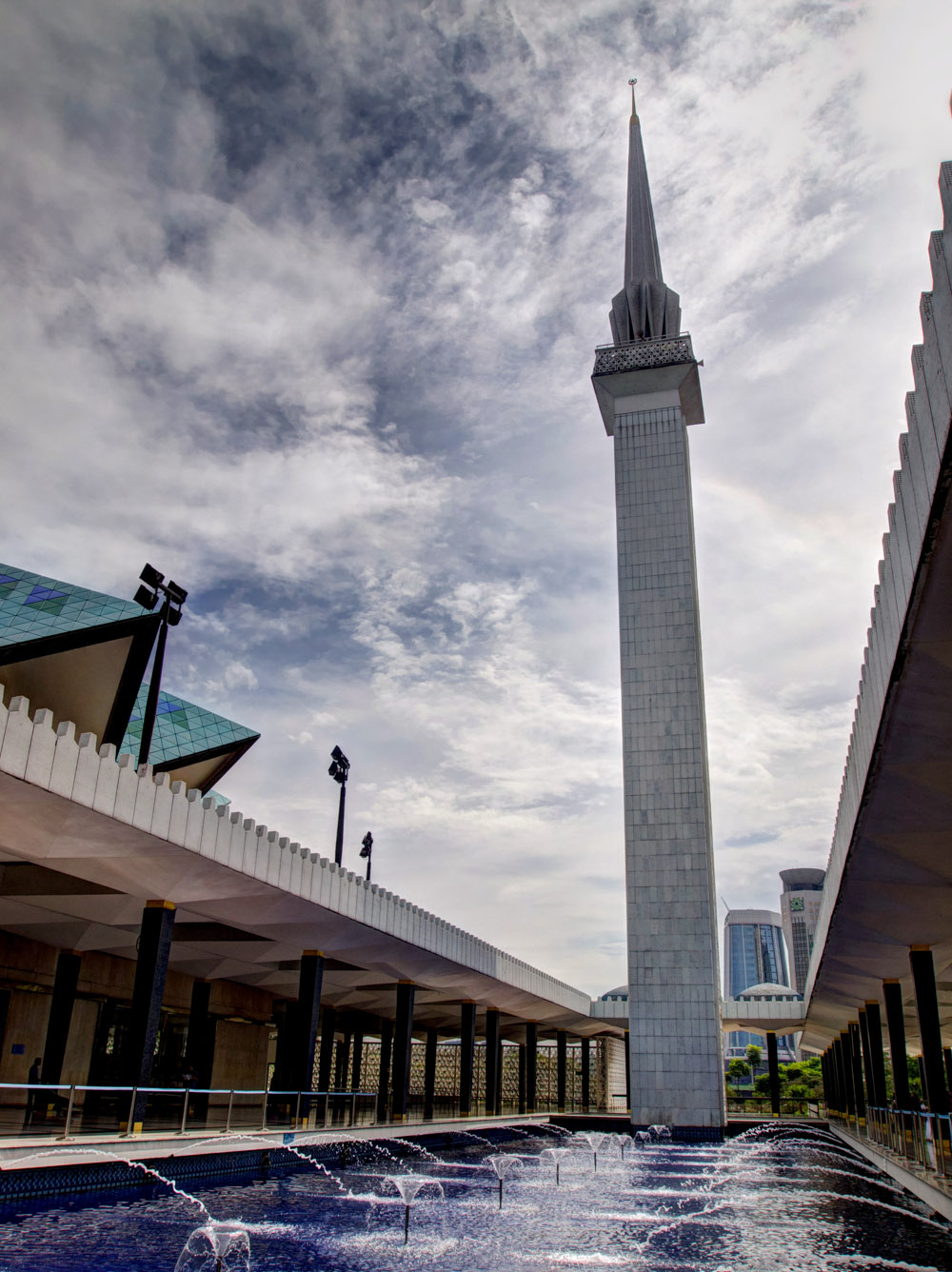
Malaysia is a predominantly Islamic country (in fact, there are more Asian Muslims than Middle Eastern Muslims), with a generous dose of religion and populace from both India and China.  I had just enough time to visit a place of worship from each region.  In an enormous and new mosque (it made me think of an Islamic answer to American mega-churches), Masjid Negara, I was terribly smitten by Islam’s love of geometry, with vaguely floral geometric designs of the highest intricacy carved into the surfaces of its towers, domes, and mathematical sculptures.

 
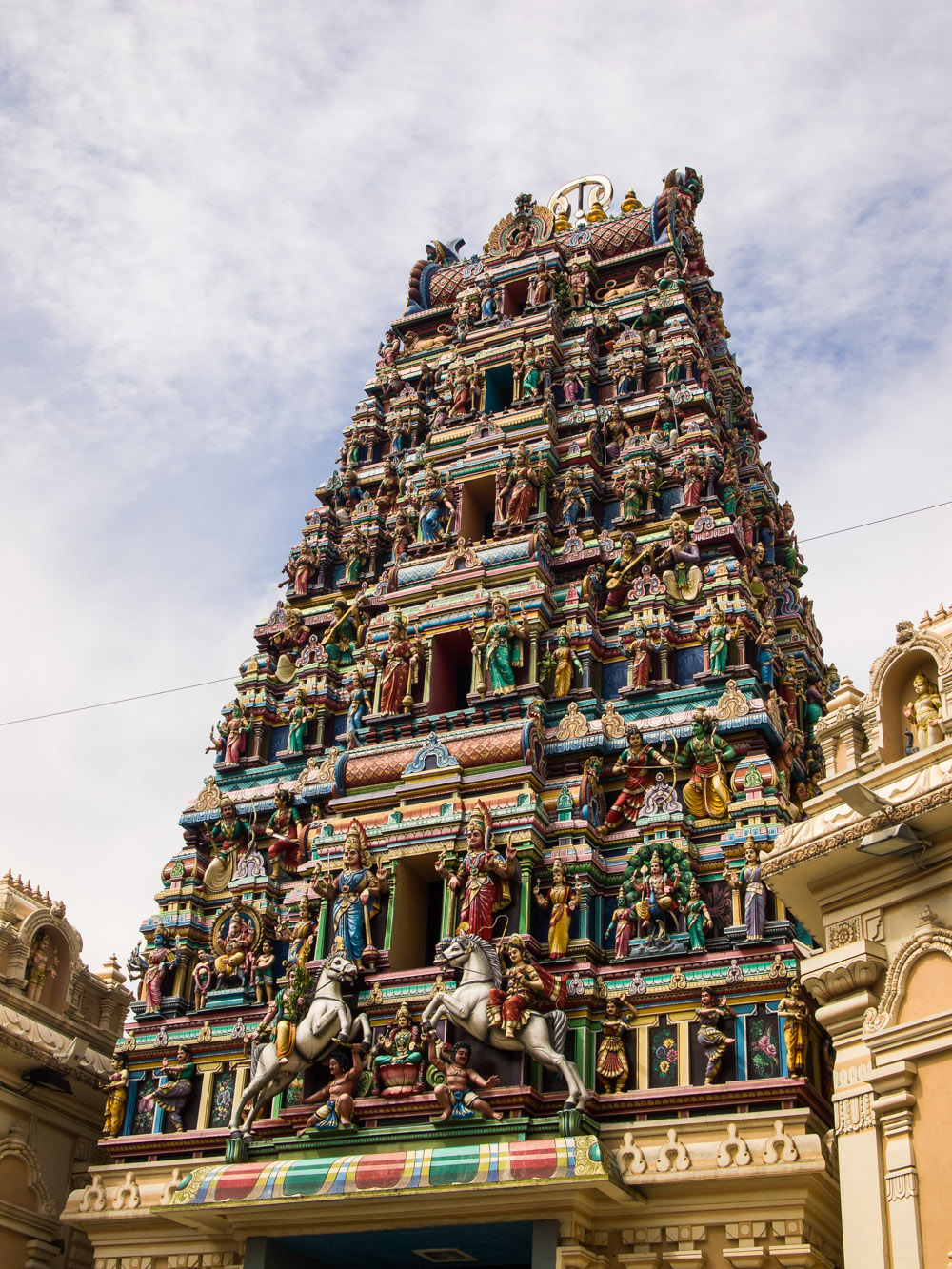
In a relatively new Hindu temple, the Sri Mahamariamman, I was hypnotized by its façade: a distinctly south Indian design, but made with cement, in immaculate condition to contrast the many ruins I’ve seen, and most surprisingly, abundant with color.  A typically complicated pantheon of Hindu deities brought to life with distinct colors for their hair, skin, saris, sashes, swords, and instruments populated the surface of the temple, and the color lended them so much more personality than I’ve seen in depictions before.  I curse my lack of time that I couldn’t study each character separately or sit and enjoy the music churning within.


And then I blitzed through my first Taoist temple, a strictly gold and red affair wafting with incense and new rituals I’ve never seen but hope to understand later.


I wish that was all I had to say about my time in Kuala Lumpur, but getting back to the airport to complete my connection to Myanmar proved to be a complete debacle, and I’m just grateful I got to airport on time.

The hour long shuttle from Chinatown to the airport leaves from KL Sentral (there’s a lot of funny spelling in Kuala Lumpur – my favorite is “teksi” for taxi), and on my walk back I could feel the sweat building more quickly than a whole week in Nepal could accomplish, so I periodically ducked my head into any air conditioned bus pointed in the same direction while parroting, “KL Sentral?”  Eventually a driver said yes with a beckoning wave of his arm, and after confirming “KL Sentral” three times with him, I thought I was on my way.

Forty minutes passed – much longer it would have taken to walk to Sentral – and the driver’s placating reassurance no longer kept me placated.  Asking around, another customer confirmed my suspicion that we weren’t head to Sentral at all, rather some city hilariously named Klang.  I had the driver halt the bus so I could cross the freeway and call a teksi from a Shell station.

A quite friendly driver scooped me up and took me to KL International, quadrupling the cost of my once cleverly cheap stay in the city.  My timing would have been quite good… if I was at the right airport.  It turned out my international flight was out of the domestic airport, a mistake I would have felt worse aobut making if it weren’t for the fact that the airport code on my ticket didn’t match either airport’s code.  I hopped on an inter-airport shuttle and held my breath until I was finally on my plane bound for Yangon.

Sunday, January 6, 2013

Swayambhunath & Patan


When I had returned to Kathmandu, there was light enough in the sky for one more tiny pilgrimage, so I set my sights on Swayambhunath, yet another beautiful and holy hilltop Buddhist monument.  Halfway up its mighty stairwell, I found myself wondering why Buddhists were such masochists and imagined they must have rock solid thighs for all the constant climbing they have to accomplish.  The place was crawling with sneering monkeys, and their omnipresence in holy places had me deciding that monkeys were by far the most pious of creatures.  Even in my fit state the steps were challenging, and I emanated waves of sympathy to the elderly I passed clinging to handrails in their persistent ascents.  Nearing the top, Buddha’s penetrating eyes stared right through me, gleaming from the top of the lofty stupa and framed by two distinctly Indian style stone towers.  Never to build stupas without epic origin tales, Swayambhunath marks the location where a giant lotus flower erupted from the valley back when it was a great lake (and on this point the lore actually matches the geology (the lake part, not necessarily the magical giant lotus)).


Turning around, I had the setting sun behind me, a perfect stage light for the endless sprawl of dusty bricks and rivers that is Kathmandu.  I thought about all the lives filling and moving about these bricks and my heart grew heavy.  Nepal faces all the economic problems as India to the south, but with some additional impediments to growth and recovery.  Landlocked with only mildly sympathetic neighbors, Nepal has no way to efficiently export the fruits of its cheap labor and goods without the disincentives of high tariffs.  Like elsewhere, the valley’s population is exploding faster than its ability to keep up, and worse, the rapidly expanding metropolis in the middle is growing with tragic neglect to the valley’s vulnerability to terrible earthquakes.  An estimated 60% of the buildings today could be toppled if the city was hit by the severity of one of the larger earthquakes that have hit it in the past, ruining more lives than I care to think about.


I did a few farewell laps around the stupa alongside rosary clutching monks and headed down the steps spilling back down to the city, stopping to scoop up a cheap mantra engraved necklace, cylindrical like a prayer wheel, and then some whiskey and soda to celebrate being alive along with my couch hosts.


The next day I set out for the neighboring city of Patan, a once rival city-state that eventually became absorbed into greater Kathmandu, well after a conqueror annexed the territories and made Kathmandu the capital of his kingdom.  The royal center of Patan, cleverly named Durbar Square, just like Kathmandu’s, is less epic in scope than its neighbor’s and therefore less attractive to the tourists.  I liked it quite a bit better.  A beautiful palace courtyard was temporarily housing some rather good international modern art.  Typical of Newari culture, there were temples paying tribute to both Buddha and Shiva alike, as well as many deities of the animist traditions that predated Hinduism in the region.  In an unmarked hole in the wall I enjoyed a traditional Newari lunch.  First an unremarkable egg fried onto a slice of bread, then curried chickpeas and very spicy potatoes that I piled onto a bowl of beat rice.  Beat rice is rice dehydrated and crushed to flakes, and ends up looking like dehydrated mashed potatoes, but with a noteworthy crunch.  I was told the rice was prepared this way to make it easier to smuggle food to Tibetan refugees living in the hills, as beat rice required no cooking and thus no flame that could give away their location at night.


Wandering in a spiral around the square, I saw a temple where every bit of its surface area was etched with identical depictions of cross legged Buddha – there were surely thousands of him.  Nearby, in the famously gorgeous Golden Monastery, I watched the head monk, an adorable little boy, fumble about the day’s rituals, lacing a deity’s three heads with marigolds and placing donated money ornamentally about the altar.  Sauntering north to a towering five tiered pagoda, I happened upon a tiny festival. To music and copious amounts of incense – whole bundles being tossed upon flames – worshippers were enjoying picnic lunches while surrendering a portion of their meals decoratively on bright green leaves as offerings to the gods (hopefully the gods were hungry).  And on the other side of the pagoda, a procession of tiny girls dressed ornately in makeup and bright red dresses, not unlike wedding saris, was parading down a column and then sat in rows to receive sweets and other gifts.  Another onlooker, one of the fathers, confirmed my suspicion that the whole ordeal was some kind of coming of age ceremony – though given the size of the girls I couldn’t reason just what age they might be coming to.  To my surprise he kept referring to that thing “girls do once a month, every month.”  These girls couldn’t have had their periods already!  And also what an odd thing to announce and celebrate so publicly.  They were too tiny – but Sophie would later explain to me that many Nepalese children are actually quite a bit older than they look, as they don’t reach nearly the mature heights that westerners do (oh, that reminds me when I was talking to two little village girls in Dhulikhel and they were chided in passing by an elderly woman no taller than they were – apparently the world’s smallest adult lives in Nepal somewhere).


My route back home (my hosts had since moved while I was on my mini-trek), had me passing once more by Pashupatinath, which was the location of the burning ghats for Shivaites.  After stealing a peek inside the main temple, forbidden to non-Hindus, and catching a view of the magnificent rump of a giant golden bull, Shiva’s vehicle, I noticed the sounds of drums and chanting coming from the ghat area.  The temple’s lights were on, despite the city being in blackout mode, so I decided to investigate.  I had since lost my pass to the place so I walked past the ticket gate with a briskness that left me unperturbed.  Halfway up the ghats on the opposite bank was a series of brightly robed dancers performed in unison with large fans.  Next to them, a delightfully crusty old Sadhu paced forward and back waving his hands and clapping occasionally, probably intoxicated.  I couldn’t figure out if his presence was integral to the performance or something he decided to add all on his own, but I couldn’t take my eyes off of him.  The music was so well mixed on the speakers I didn’t realize it was being performed live until I saw drummers and a singer bleating into a microphone.  When the musicians finished, sections of the audience paced down to the water bank to offer prayers and cast flower pedals down the stream.  With the enchanting rituals and stark nighttime lighting in a place I had already fallen in love with, it ended up being a truly beautiful series of moments and a perfect last night for me in Nepal.


A failed attempt to connect to the internet (no power of course), two laps around Boudda (where white hippies were laying hands on locals, talking in tongues and describing how “now your chest pain is gone, your headaches are gone, cancer is gone”), and a jaunt through a forest back to the airport, and I was back in the air.  The pilot mentioned that visibility should be such that we could see Everest from the left side of the plane.  I was on the right side.  Was I going to get to see Everest after all?  When someone on the opposite side got up to use the toilet, I pounced upon his seat and pressed my face to the window.  I scanned the jagged horizon and fixed my eyes on what appeared to be the highest peak on the range.  Snapped a few photos.  It was difficult to tell.  Did I see it?  Mt. Everest?  Having to ask the question deflated the sense of fulfillment I was hoping to achieve – the value of seeing anything for that matter.  To think I perhaps saw something important, but wouldn’t know without a reference, as if I needed someone to tell me whether I experienced something or not.  I sat for a while frustrated before realizing there was someone right next to me waiting patiently for his seat back.  I resolved to later check my photos against Google image search to determine whether I did in fact see Everest, and gave the gentleman his seat back.


(I neglected to check until about two weeks later, but it turns out I did see Mt. Everest.  Yay.)

Tuesday, January 1, 2013

Dhulikhel, Namobuddha, & Panauti

On the cramped bus halfway from Kathmandu to Dhulikhel, I was sizing up a colossal statue of Shiva overlooking the valley.  Based on the relative size of the buildings adjacent, I would have to guess it was about 10 stories tall and could be seen for miles.  Dhulikhel, my destination, is an old Newari village with supposedly impressive sunrise views of the Himalayas and an important gateway for trekkers or those looking for the one passage into Tibet.  The Newari people are somewhere in between Hindus and Buddhists, with Buddha and Hanuman sharing seats in the same pantheon alongside animist spirits from religions past; they treat religion like it’s a buffet, with a little bit of this and a little bit of that.


After I arrived in the village and found the cheapest room in town (complete with questionable bed sheets and a washroom that leaves you feeling dirtier than you were before) I had nothing in particular on my agenda until the next day’s sunrise.  In my attempts to make the most of my whirlwind tour, I had always kept my days packed, but now I had a whole day with nothing to accomplish.  No don’t-miss sight, palace, museum, show, or culinary delight.  Just me and a village.  So I spent the day ambling about listlessly, trying to enjoy the calm that’s become so scarce in my life recently.  I talked to locals, read a book, geared up for my little trek the next day, and drank a lot of tea.  The trouble with being a westerner among villagers is your presence divides them into two camps.  Either they don’t know  any English and you’re limited to brief nonverbal encounters – I helped an old woman get a ridiculous stack of wood onto her back that she balanced in place with a sling attached to her forehead – or they know English because knowing English helps them hustle westerners out of their rupees.  

There is a very small third camp that know English and are simply sociable, just wanting to get to know a traveling foreigner, but the pain is they have the same opening lines as the hustler, and you’re always anticipating the inevitable, “come look at my shop,” or, “ look at this bird I carved; it’s only 200 Rupees.”  It’s enough to make a cynic out of anyone, can be very wearing on your patience, and diminishes the value of trying to connect with locals when traveling.  And they learn to hustle young.  Many poor kids are instructed on how to make warm connections with foreigners before begging for money, a sad attempt at wining and dining before the actual begging, which I’m sure is much more successful at begetting sympathy than the point blank, “RUPEES!?!” approach.  There’s an unwritten script they follow, and it varies from region to region.  It can be comical how word for word identical many of the conversations I’ll have with touts in one place.  As if rehearsing a scene on stage, you know what they’re going to say before they say it.  But sometimes it takes you by surprise, and I’ve had many lovely seeming moments putter out like a leaky balloon by beggarly punch lines.  It’s a struggle, but it’s worth holding out for the occasions that are all the way genuine, as those are the ones you get to carry with you.

There’s little to do in a village with no electricity after dark and I had no difficulty making it to bed early enough to enjoy a complete rest well before sunrise, even if it was a full five hours before I had been waking up in the days preceding.  I planned every step I’d have to take in the morning so there wouldn’t be any delay, and after my alarm went off and I swiftly left my room, I was aghast to find there was no way out of the hotel.  Every door had been sealed and locked.  I was outraged, not only because this impediment was keeping me from the main reason I came to this damn village, but also because of my very American concern for liability.  I imagined a fire killing everyone inside because the owners locked it down tight.  I almost jumped out the second story window, but reasoned it was both too great a risk and a little too dramatic.  I found a woman upstairs sweeping the stairwell who unlocked the front and saw me take off like a racehorse at the gate.

Walking briskly, I commanded the attention of some stray dogs, dogs I was discovering didn’t much care for tall white people wearing hats.  They let me know with growls and bared fangs, aggressive to the point I thought they might actually attack.  A young Newari man behind me scared them off with rocks and hisses.  He was on his morning walk, also to the climb the hills under Kali shrine where I was headed, so we kept each other company, exchanging conversation between our uphill panting.  It turned out he has family all over the states and tries every year for the diversity lottery.  He also sings classical Newari songs and plays the violin, but not at the same time.


We had missed the beginning of the sunrise, but it turned out not to be so much of a loss.  The most captivating part, the lower mandible of frosted jagged peaks that composed the most domineering stretch of Himalayan mountains within view, lay further to the north and their viewing would actually benefit from the sun’s further ascension.  East by southeast where the sun was rising, its warm light was trapped in lagoons of mist hovering between the valley’s hills, imbuing them with a mysterious glow.  I learned that such a clear view of the Himalayas was a very rare thing outside of December, and counted myself lucky about my timing, despite the additional dose of cold weather the season brings.  I did not, however, get to see Everest among the peaks.  It lays quite a bit more eastward than I realized when I planned my trip, requiring a flight to get to a vantage point and therefore more costly in time and dollars than I could afford.  So I tried not to be too disappointed, despite the withering of my assumption that my eyes would fall upon our planet’s highest peak during my time in Nepal.


Most of the villagers in the hills are farmers, and they leave their mark on the country side with endlessly tiered farm rows, swooping up and down each hillside with right angle gradients, as if a topographical map had sprung upward to life in a way that was manifested as literally as possible – that is to say without the smooth natural curves we normally expect from hill surfaces.  Flowing strips of rice, soy, grass, and corn were woven about everywhere you looked, and made for very hypnotizing hiking scenery.
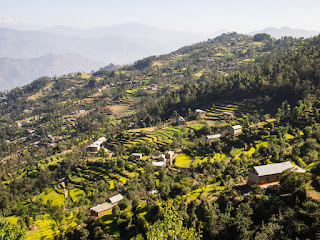

The dramatically fluctuating temperature in the Kathmandu valley demanded constant adjustment of my clothing as I passed in and out of shade, as my pace changed to according to the incline, and as the sun climbed higher in the sky.  My shawl popped in and out of my bag, my scarf snaked around from around my face, to a bundle around my neck, then loose around my shoulders, and back again, and my layered sleeves shot up and down my arms like pistons in an engine.  Occasionally a bus would pass, overflowing with Nepalese sticking out of windows and stacked on the roof.  A few were party busses full of young people on their way to a plateau blasting Rihanna remixes that filled the valley for all the goats, cows, and chickens to enjoy.

Frosted in gold by the backlighting of the sun, my destination came full into view after one last bend of the forested ridge trail.  Mounted at the top of a sizable ridge overlooking the Kathmandu valley, lay the Tibetan Monastery, Namobuddha.  A steep shaded path marches up the side, lined every step of the way by brightly colored prayer flags woven through the dense boughs of low crooked trees.

The noise and movements of weekend tour groups at first diminished the beautiful piety of the place.  Busloads of students from the capital were absurdly thorough about having their photos taken in front of every inch of the monastery, no matter how mundane the subject.  The manager’s office seems like a good place to strike a cool gangsta pose.  How about this picture of another monastery hanging on the wall of the monastery?  Let’s get a picture of me being the duck faced club hopping thug that I am in front of this picture of another monastery while I’m in this monastery?  Oh, we forgot to vogue out in front of this fern.  Good stuff.
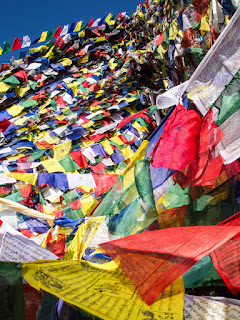

Eventually they filed back into their tour busses and the hilltop ambience of monastic solitude slowly seeped back to fill the halls.  At the very top of the hill lay a stupa where you can listen to the hushed thunder of ten thousand prayer flags being tugged by the mountain wind.  They are tied so densely together and so close to the ground you need to use amateur acrobatics to circle the stupa completely.  The stupa marks the place were supposed a prince happened upon a hungry tigress about to lay upon a young girl, so that she may feed her young waiting in a nearby cave.  The prince empathized with the tiger and offered his own flesh to save the child, and was therefore canonized by the Buddhists.  The gilded main hall of Namobuddha is dazzlingly red, and then made more vibrant with heaps of intricate gold detail.  After the sun set on the valley, I eagerly looked forward to sitting in on my second puja ritual.  Again I listened to the practiced low grumblings of monks in prayer and marveled at the precision in which they evoked that distinct sound of calculated chaos, read from scrolls written centuries ago.  With the shock lessened by increasing familiarity, I watched the monks’ performance with greater scrutiny and what I saw was someone demystifying.  Some of the monks, they seemed bored.  I saw chuckling when the altar boy dropped something.  I caught one taking a thorough pick at his nose.  Puja isn’t performance art, it’s ritual, and a chore, and while the atmosphere it creates crushes me deeply in the best way possible, it’s merely habit for them.  Seeing Puja this way made it seem a tad less otherworldly and a lot more human.

When the last flush of color fled the valley after the sun and the horizon no longer visibly cleft the ground from the heavens, the folds of the now black hills became dotted villagers’ gas lamps, blinking softly and echoing the stars in the sky.  The monastery has two guesthouses for foreign travelers, one for those in long term monastic retreats and one for those passing through like myself.  Either way, the guests are invited to join the monks for dinner in their mess hall, a long cafeteria that would be otherwise unremarkable if it weren’t for the many tiny Buddhas carved into the walls.  Over a thousand by my rough calculations.  I was expecting a meal of Daal Bhaat – a simple rice and yellow lentils dish that many Nepalese eat for breakfast and dinner every day of their lives – but was treated instead to a savory stew with the most wonderfully thick noodles and served with an optional and very potent red chili sauce that I believe I was the only foreigner to partake of.  Breakfast was black-eyed peas served with a large knot of deliciously fluffy dough and Tibetan tea, which is made unpleasantly thick with butter. 


I wished I could stay longer, but I had to keep moving.  I found the monks were very polite and they were helpful when I needed guidance, but I was hoping to make a better connection and learn more about their lifestyle and beliefs.  It seemed they preferred to keep to themselves, so I left without having figured them out to the extent I was hoping for, but I later figured there was still a lot of Asia to cover, so I had nothing to despair about.

Hiking westward now, I paused to snack on some masala flavor Lay’s potato chips in a village called Sangkhu, and I was approached by two young village girls on their way from school.  They were probably 12 and six, and the older of the two spoke English quite well and served as a translator when her illiterate and widowed aunt, with a face more lined than the hillside farms around us, squatted down on the road next to us.  The aunt wanted to know if I could get her son a job in America, and threw her hands in the air in mock despair when she was told I don’t have a job for myself in America.  Then she said I should marry her daughter, as she’s very beautiful and hard working too.  I couldn’t be sure if she was joking or not.  Nepalese women are indeed hard working.  In all hours of the day, I could see them hunched over in farm rows or transporting absurd loads of goods on their backs supported with forehead slings.  I very rarely saw men toiling in the fields, and I’ve read women are still regarded somewhat like property in rural Nepal, expected to work all day in the fields and yet still be home fix meals for the family.

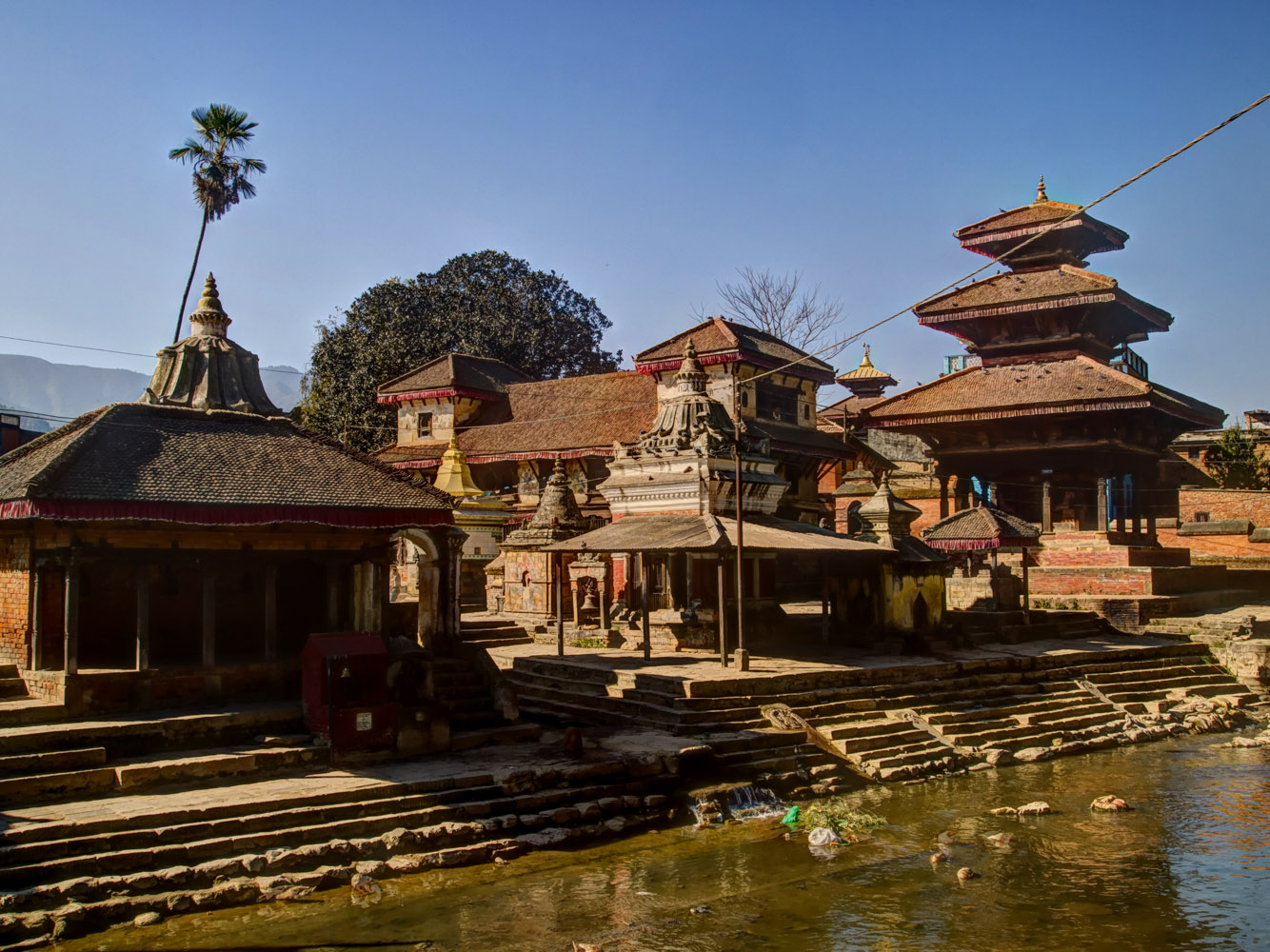
My last stop before returning to Kathmandu was a very well preserved Newari village called Paunati.  With aching feet I came to where two rivers met and the old village began, but found myself heartbroken when I arrived.  The myriad temples and shrines around the ghat lined river were entirely lovely on their own and at the moment alone for me to explore, but like so many other places I’ve been to, the place was just drowned in garbage.  Ducks swimming in the river have to navigate tiny islands of bags, styrofoam, and plastic bottles, islands that became impenetrable continents of trash further downstream.  This, all in the same water so revered they bring their dying elderly to douse their feet in it and then latter scatter their ashen remains when they’re gone.  In my short two months in Asia, I’ve seen this rampant environmental carelessness over and over and should now expect nothing better, but somehow the neglect hit me worse there in Panauti, and I have waking terrors of nations of people up to their necks in their own shedded refuse.

Wednesday, December 26, 2012

To Kathmandu

My flight to Kathmandu was to pass through New Delhi with an eight hour overnight layover.  Ever the cheap-ass, I was determined to crash in the airport, even though I wasn't sure that was possible, and I'm surprised now at my audacity, as I didn't even bother with a contingency plan.  I think I was inspired by the fields of human bodies I've seen strewn about the ground as I've passed my weeks in India, mostly in places of transit.  If Indians can do it, then by Jove, so can I!  Often covered entirely with little more than a shawl, and on hard concrete no less, I am surprised I never tripped on one of the many impromptu Indian nappers I've come across.  I’ve gotten very close to doing so.

There was a nasty snag in my plan, in that my bag wasn’t scheduled to be forwarded to Kathmandu, which meant I had to exit the airport security zone to retrieve it.  A nice man at an information desk said I should be able to come back in and use the lounge, but the stern Sikh security guard I bumped into later insisted otherwise, and then I was stuck outside (guards and cops are often Sikhs, and they are often quite large and very intimidating).  Dismayed, but determined not to go through the expense and hassle of two cab rides and a hotel for a measly couple of hours of sleep, I slipped into the visitors section, unfurled my shawl onto a corner of cold tile, and – once more inspired by India’s intrepid sleepers – went into hibernation mode using ear buds and my hat to block out the world.  The tiles were hard, and the nearby motion sensor doors let whole drafts of cold winter air into the room.  All the while I was expecting someone to come tell the scruffy homeless white guy curled up in the corner he couldn’t be there, but the hours slipped wearily by, alternatingly on my tender left and right sides, and I got up in time to check into my flight unperturbed.

As I dismounted the vehicular staircase heading from the plane to the airstrip, I was surprised at how very temperate the morning air of Kathmandu’s winter could be.  Seeing the bony white spine of the Himalayas from the airplane high above gave me a thrill but also chilled me.  My host, a great French woman named Sophie, insisted she meet me at the airport, as too many of her guests have gotten lost trying to navigate the bustling mess of Kathmandu’s transit system.  The busses proved to be just as crowded as Indian busses, but with the added fun of being built for considerably smaller human beings.  Or hobbits perhaps.  I was like Gandalf hunched over in a moving hobbit hole full of little brown Frodos wearing facemasks to filter out the pollution and the dust.

Sleeping Vishnu

In the bus and on the streets, the Nepalese dislodged some of my expectations.  Despite being so historically cut off from the world, the Kathmandu Nepalese were dressed in a much more western way than the people in any of the Indian cities I had visited.  Lots of V-neck sweaters and converse shoes.  The dress also somewhat masked the extreme poverty of the country.  Even the poor need to stay warm, and I think all the layering with sweaters, scarves, and hats lends itself to a blurring of social caste, at least on the level of visual inspection.  I thought of an episode of 30 Rock where Liz Lemon laments New York’s winter: “I hate January, it's dark and freezing and everyone's wearing bulky coats. You can do some serious subway flirting before you realize the guy is homeless.”


Familiar Bollywood songs in rickshaws and restaurants proved to be one of the many strong cultural tethers between Nepal and the country I had just left, but I was finding myself frustrated at having to start from scratch, despite the similarities.  The food, the religion, and even the temperaments were familiar to me, but I would say all presented itself more mildly than their brightly colored and spicy neighbor down below.  I think I was a little disenchanted by the contrast at first, but I think I’m starting to fall for it.  It’s a slow burn.


My tradition, as I’m sure is the case with many, is to start my explorations of a city at its heart, but this is a strategy I’m considering revising.  In Kathmandu’s case, the span between Durbar Square – the old royal complex – and the tourist village to the north embedded in Thamel prove to be the densest center for commerce and tourism.  Despite the majesty of the palace and the energy and flavor of the markets, I found myself out of place and out of patience with the touts, shopkeepers, and would-be tour guides that are so abound where the tourists spend their money.


The next morning I headed straight for Pashupatinath, regarded by many followers of Shiva as one of the holiest places on Earth.  You wouldn’t guess that from the state of the grounds leading to it, littered with trash occasionally piled into heaps and set ablaze.  Dodging the plastic smoke made me want to invest in one of those cotton face masks that are so fashionable here.  Entering the complex, though, it becomes clear that not all of the hazy smoke stacks floating above the temple tops emanate from trash piles.  Maybe six steps up from the water on one of the ghats, I spied a man stoking the flames of a pyre with a long rod, and a human foot flopped limply out from between the timbers.  Scanning up and downstream, I realized this particular smokestack was just one of several funeral pyres dotting the banks of the river.  It is believed that to have your remains scattered here frees your immortal soul form the cycle of reincarnation.  It is illegal now, but widows used to join their husbands here in immolation, in a ritual suicide known as sati.


I was a bit uneasy strolling about such an intense and emotionally charged place, especially with a camera dangling from shyly from my side, but the administration made a special effort to be welcoming, emphasizing the importance of tourist dollars in the site’s maintenance.  Most of the photos I shot, I shot from the hip, not wanting to be prying.  A Japanese tourist was getting very conspicuous shots of a body being prepared for cremation – they seemed to be washing the corpse’s face or perhaps attempting to get it to imbibe – and a mourner assailed the photographer with curses and the restrained violence of a fist in the air.  I took that as a cue to explore away from the ghats, as mesmerizing as they were.  I suspect the sad serenity of the scene there will haunt me always and despite the bleakness, I was very in love with the place.


Up the hill on the opposite bank, are countless rows of stone shrines, each containing a Shiva linga phallus.  The shrines happen to be a popular hangout for sadhus and monkeys alike.  Sadhus like to party, and I was told a yearly festival sees that they get as much liquor and marijuana as their wrinkled old faces can handle – all for free.  The hill also contains a wildlife enclosure where I saw some squat deer sitting among sunbeams and a gorgeous black buck with spindly helix-shaped horns gallivanting along the ridge.


Half an hour north by foot, I had my first full introduction to Tibetan Buddhism, in the shape of the Boudhanath: an enormous half dome shrine, called a stupa, topped with a golden spire and four pairs of Buddha’s eyes gazing in each direction.  Thousands of brightly colored prayer flags on streamers fly in the wind and converge at the base of the spire.  At the base of the monument on every side is a vast series of prayer wheels, bronze colored cylinders etched with mantras and spun by hand by the hundreds of pilgrims circling the giant stupa, always clockwise.  Outside and inside the flowing ring of Buddhists, more Buddhists stand with flat shields on the palms of their hands, protecting them from abrasion as they prostrate themselves on the ground repeatedly in prayer.  Boudhanath is regarded as the most important Tibetan Buddhist monument outside of Tibet and is frequented often by exhiles.

After some tasty Nepalese noodles, a dish called Thukpa, I found myself wandering the markets further north of the stupa.  I became entranced by a wild sound emanating from a nearby monastery and I kicked off my shoes at the entrance to investigate.  As soon as I entered, the sound suddenly stopped, increasing my timidity as I looked across several rows of maroon clad Buddhists fanning to my left and right, all deeply focused on long scrolls.  My eyes adjusted blinkingly to the lack of light and I was stunned by the colors of the place: drenched in bright red, and accented with a generous amount of gold, a bit of white, and a smattering of just about every other color there is.  A smiling monk beckoned me to sit and then administered to me a spoonful of blessed water and a glass of hot chai.  From my cushion in the corner of the monastery I sipped my tea and listened in wonder as the wall of sound that summoned me moments before slowly reconstructed itself before me.


First, a throaty grumble from somewhere near the front of the chamber, a practiced chant that became echoed by each of the monks down the rows.  This continues hypnotically for a few minutes until two pairs of monks with large unwieldy horns blow into them, loosing a discordant howl, deafening in their unison.  A pair of monks by the doors banged on heavy drums with large mallets while the others joined in with cymbals, bells, double-sided hand drums, and fluttering smaller horns.  Banging, crashing, wailing, the carefully timed cacophony is terrifying and beautiful all at once.  It’s a stampede of elephants, it’s the beginning of time, it’s the awful grace of a controlled demolition seen in slow motion, and it leaves the uninitiated in a state of stupor when it all ends more suddenly than it began.

Like a vampire, the cold descends upon the town at night, rolling down from the chilly Himalayas.  In the span of an hour or two I would have to go from having my sleeves rolled up to wearing every shirt I brought with me then tightly bound in my Rajasthani scarf and shawl.  The air is bad in Kathmandu and the water’s worse, tinged with brown even after a boil.  Muddy glacier runoff and just as cold.  I was naked and watching the glacier water trickle from the shower head, chuckling aloud while wondering about my bravery.  The neighbors upstairs would have heard a rather loud, “Oh sweet Jesus!” and I then figured I could probably get by the rest of my time in Nepal without showers, save for a daily foot wash.

Oh my poor feet.  I’m not halfway through my adventure through Asia and they already barely resemble feet.  An unfortunate patchwork of pink, purple, and white.  Scabbed from shitty sandals.  Lumpen from ceaseless wandering and a tightwad’s aversion to taxi cabs.

The glacial shower – I  forgot to mention – was enjoyed by romantic candlelight.  Nepal, in order to afford petrol, sells off its electricity to India.  The electricity sent south, however, is not surplus, which means the whole country goes off the grid every day for about 10 hours.  If businesses can afford it, they keep the lights on with generators, otherwise it’s candle time or shop’s closed.  Much of my writing in Nepal so far has been by the soft glow of a candle and the burning tip of sandalwood incense.  It takes some getting used to.